
What Are Physicians Asking AI? A JAMA Study of 952,008 Clinicians
This post may contain links from our sponsors. We provide you with accurate, reliable information. Learn more about how we make money and select our advertising partners.
Last updated: November 6, 2026. Based on a JAMA study published October 15, 2026.
Nearly a million U.S. clinicians, more than half of them physicians, have left a record of what they ask AI, and a new JAMA study just analyzed it.
The short answer: U.S. clinicians, including 556,200 physicians, asked OpenEvidence, an AI clinical information platform, 271 million questions between January 2024 and June 2026. Among physicians, treatment and management questions (33.1%) outnumbered diagnosis questions (13.9%) by more than two to one. Nurse practitioners and physician assistants asked the most questions per user, and early-career physicians used the platform well above their share of the workforce, according to a study published in JAMA on October 15, 2026.
The study fills a gap. Its authors note that empirical evidence on how doctors and other clinicians use AI tools has been limited. It covered everyone on the platform, and the rest of the users included nurse practitioners and physician assistants, so some figures below describe all clinicians and others describe physicians only. Each is labeled.
Researchers at Harvard Medical School and Mass General Brigham conducted the study with co-authors from OpenEvidence and other institutions. Three co-authors were OpenEvidence employees, and the company supplied the data, which readers can weigh when reading the results.
Disclaimer: While these are general suggestions, it’s important to conduct thorough research and due diligence when selecting AI tools. We do not endorse or promote any specific AI tools mentioned here. This article is for educational and informational purposes only. It is not intended to provide legal, financial, or clinical advice. Always comply with HIPAA and institutional policies. For any decisions that impact patient care or finances, consult a qualified professional.

Key numbers at a glance
| Measure | Finding |
|---|---|
| Study period | January 1, 2024 to June 30, 2026 |
| Clinicians (all) | 952,008, including 556,200 physicians |
| Questions submitted (all clinicians) | 271 million |
| Monthly active users (all clinicians) | 355 (January 2024) to 703,265 (June 2026) |
| Questions per active user per month (all clinicians) | 18.0 to 39.5 |
| Questions per active user per month (physicians) | 37.1 |
| Top physician purpose | Treatment and management (33.1%); diagnosis (13.9%) |
| Questions outside own specialty (physicians) | 35% (oncology and hematology) to 88% (emergency medicine) |
Source: Patel et al., JAMA, October 15, 2026.
What did the JAMA study look at?
The researchers analyzed accounts verified through National Provider Identifier numbers, so every user was a licensed clinician. In all, 952,008 clinicians, including 556,200 physicians, submitted 271 million questions over 30 months.
Nobody can read 271 million questions by hand. The team took a random sample of 38.8 million, built to represent different user groups, and used a large language model to label each question by clinical purpose and topic. The category percentages come from an AI classifier, not from people reviewing each question.
How fast is clinician AI use growing?
In January 2024, 355 clinicians used the platform in a month. By June 2026, the monthly count was 703,265. Average questions per active user rose from 18.0 to 39.5 each month, so more clinicians joined and those using it asked more. Becker’s Hospital Review reported that month-to-month retention climbed from about 70% to 90%.
Who uses clinical AI the most?
Nurse practitioners and physician assistants each averaged 44.5 questions per active user per month. Physicians averaged 37.1.
Career stage showed a larger gap. The study reports a “use ratio,” which compares a group’s share of questions with its share of the national workforce. A ratio of 1.0 means use in proportion to size. Physicians within a decade of graduation scored 2.54, and residents and fellows scored 1.84. Becker’s reports the same pattern in raw shares: physicians within a decade of graduation were 24.3% of the physician workforce and sent 61.8% of physician questions.
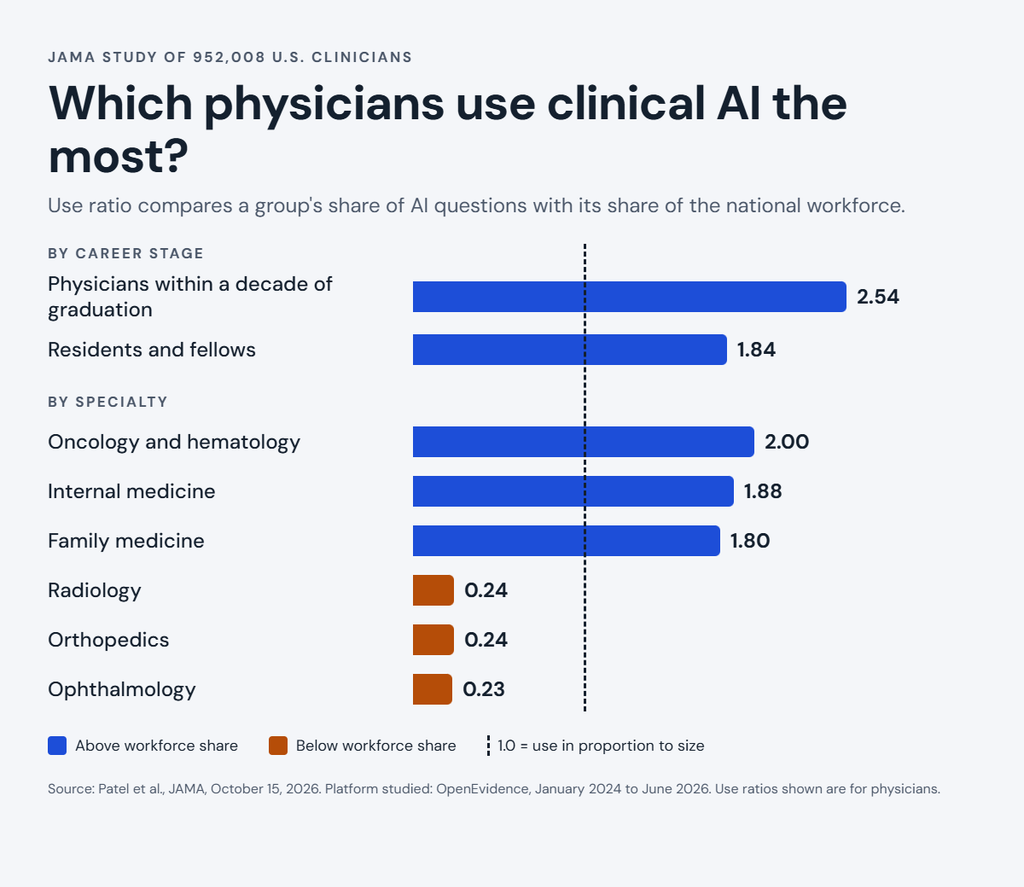
Specialty mattered too. Oncology and hematology (2.00), internal medicine (1.88), and family medicine (1.80) ran above their workforce share. Ophthalmology (0.23), radiology (0.24), and orthopedics (0.24) ran far below, at roughly a quarter of their share. The study describes these patterns but does not test why they exist.
What do clinicians ask AI about?
Most questions (51.9%) concerned clinical decision-making. Among physician questions, treatment and management made up 33.1% and diagnosis 13.9%, so physicians asked about treatment and management more than twice as often. The authors conclude that use was “frequently for treatment decisions rather than diagnostic tasks.”
Becker’s reports that the authors see a gap here: most clinical AI evaluations test diagnostic accuracy and knowledge recall, while treatment selection, medication guidance, and evidence synthesis remain largely unmeasured. The paper does not explain why clinicians ask about treatment more.
How often do physicians ask outside their own specialty?
It depends heavily on the field. Among oncologists and hematologists, 35% of questions fell outside their specialty. Among emergency department physicians, 88% did. The authors caution that part of this pattern may reflect how broad the platform’s content is, since it has content partnerships with several major medical publishers. The study does not explain the rest.
What can’t this study tell physicians?
Several limits matter before anyone repeats these numbers.
The study measured users, questions, share relative to the workforce, and the purpose and topic of questions. It did not measure accuracy, safety, or patient outcomes. A tool can be widely used and still be right or wrong in any given answer, and this study cannot separate the two.
It covers one platform, and the authors note that patterns may not carry over to tools with different content access. The data also end in June 2026.
The authors’ ties matter as well. According to the JAMA disclosures, a co-lead author was a salaried OpenEvidence employee, and OpenEvidence provided the data and contributed to the analysis. Becker’s reports that two other co-authors, including the company’s chief medical officer, were also employees. The paper went through JAMA’s peer review, and the disclosures are public, so readers can weigh them alongside the findings.
Becker’s also notes that the authors treat their counts as lower bounds, because the study included only questions typed into the platform’s main interface.
How should physicians read a usage study?
Studies about AI in medicine answer different questions. A usage study asks who uses a tool, how often, and for what. An accuracy study asks how often the tool is right. An outcomes study asks whether patients did better.
This paper is a usage study, and a cross-sectional one, which describes patterns in data collected over a period. It can show that early-career physicians use the platform more. It cannot show that using it changed their care, learning, or careers. JAMA ran an editor’s note with the paper, noting that these tools affect how clinicians learn and weigh evidence, not only how they look things up.
Three questions help with any study of this type. What exactly was measured? Who supplied the data and helped analyze it? Does it say anything about quality, or only about popularity?
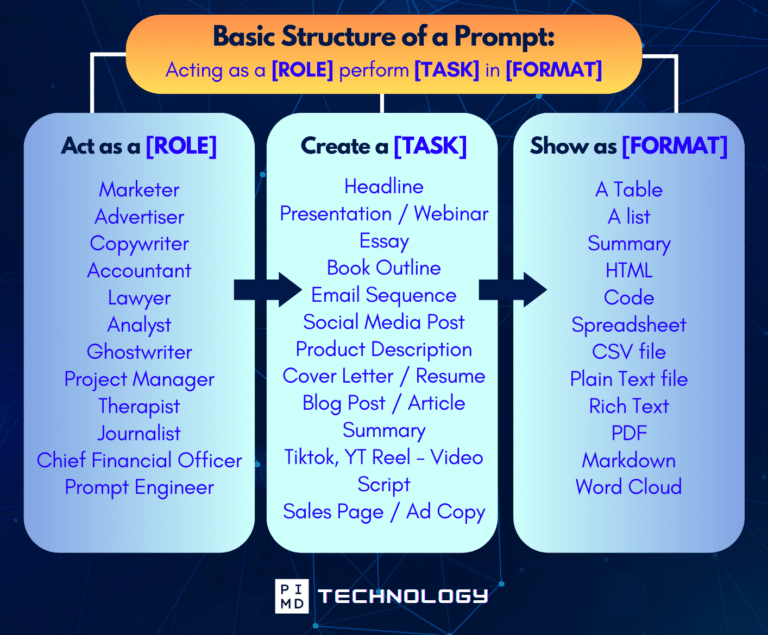
Unlock the Full Power of ChatGPT With This Copy-and-Paste Prompt Formula!
Download the Complete ChatGPT Cheat Sheet! Your go-to guide to writing better, faster prompts in seconds. Whether you’re crafting emails, social posts, or presentations, just follow the formula to get results instantly.
Save time. Get clarity. Create smarter.
The bottom line
AI clinical reference tools are now part of everyday work for many U.S. clinicians, physicians included, and use is still growing. Treatment questions outnumber diagnostic ones, early-career physicians and nurse practitioners and physician assistants use the platform most, and many questions reach beyond a clinician’s own specialty.
The study leaves accuracy and patient outcomes open, and those need other kinds of research. Until then, a usage study like this one is best read as a measure of adoption, not of quality.
What do you think? Do you agree with what the research found? Let us know in the comments!
Download The Physician’s Starter Guide to AI – a free, easy-to-digest resource that walks you through smart ways to integrate tools like ChatGPT into your professional and personal life. Whether you’re AI-curious or already experimenting, this guide will save you time, stress, and maybe even a little sanity.
Want more tips to sharpen your AI skills? Subscribe to our newsletter for exclusive insights and practical advice. You’ll also get access to our free AI resource page, packed with AI tools and tutorials to help you have more in life outside of medicine. Let’s make life easier, one prompt at a time. Make it happen!
Disclaimer: This article is for general informational and educational purposes only. It does not constitute medical, legal, compliance, or professional advice. The information provided here is based on available public data and may not be entirely accurate or up-to-date. It’s recommended to contact the respective companies/individuals for detailed information on features, pricing, and availability. All screenshots, if any, are used under the principles of fair use for editorial, educational, or commentary purposes. All trademarks and copyrights belong to their respective owners.
If you want more content like this, make sure you subscribe to our newsletter to get updates on the latest trends for AI, tech, and so much more.
Further Reading
Disclaimer: The topic presented in this article is provided as general information and for educational purposes. It is not a substitute for professional advice. Accordingly, before taking action, consult with your team of professionals.