
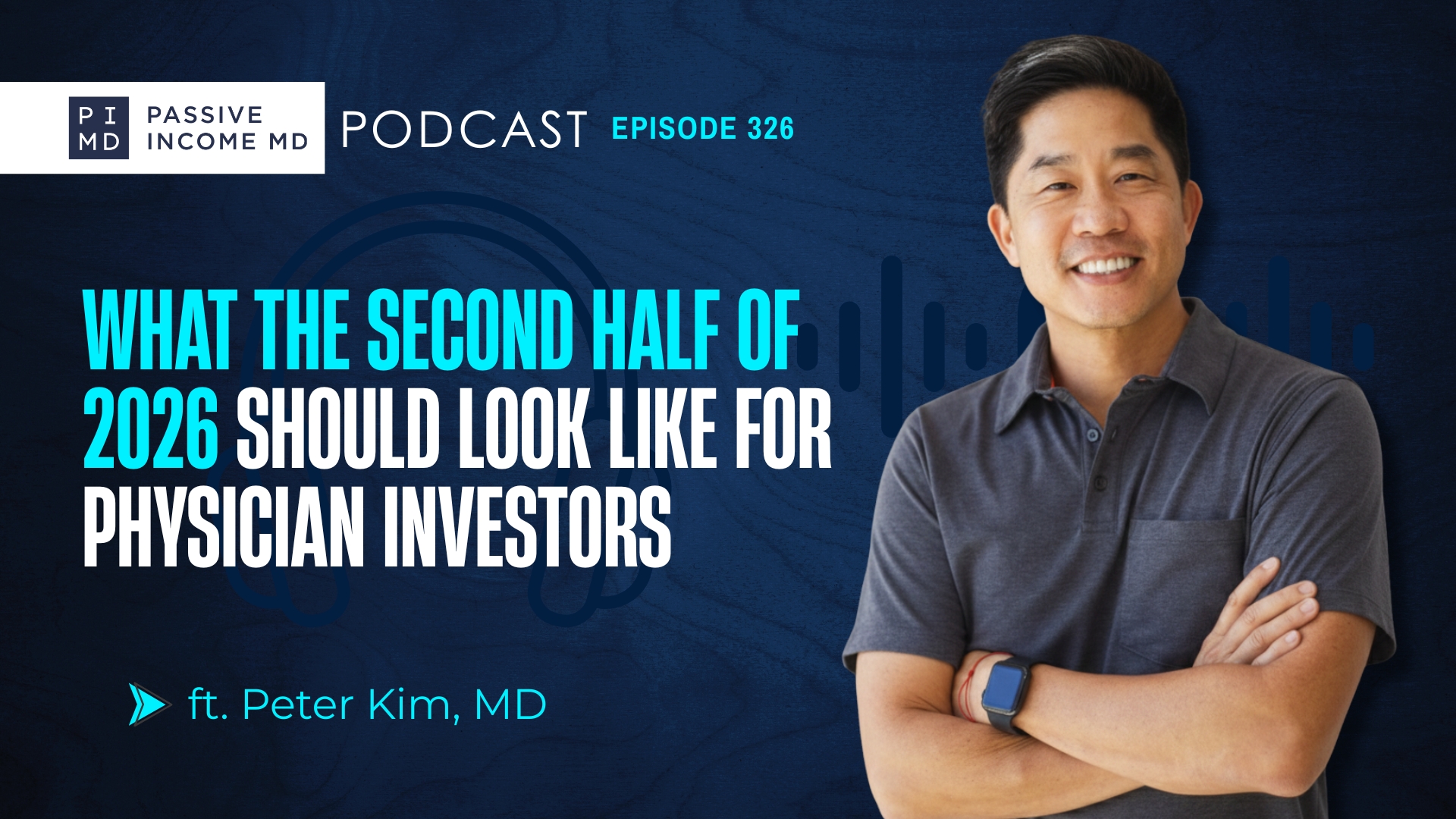
#326 What the Second Half of 2026 Should Look Like for Physician Investors ft. Peter Kim, MD


Episode Highlights
Now, let’s look at what we discussed in this episode:
- A Wedding Conversation About the Economy
- Why Nobody Called 2026 Right
- Staying Patient on Real Estate
- Staying Consistent with Index Funds
- Getting Ahead on Tax Strategy
Here’s a breakdown of how this episode unfolds.
Episode Breakdown
A Wedding Conversation About the Economy
Peter opens with a story about sitting at a wedding table with people he only knew casually, and somehow ending up in a genuinely honest conversation. Someone brought up how fast the year had gone, which led to talk about the World Cup, the war, kids heading back to school, and eventually the economy itself, the stock market, real estate, and interest rates.
At some point, the guy sitting next to him, who works in finance, turned and asked Peter directly what he was actually doing with his own money right now. That question became the whole reason for this episode. Peter frames the rest of the conversation as basically repeating what he told his friend at that table.
Before getting into it, he’s upfront that everything he’s about to share is his own personal thinking and not financial advice, since every situation is different. He sets up the episode by pointing out that nobody predicted where 2026 actually ended up, which becomes the foundation for everything he says next.
Why Nobody Called 2026 Right
Peter walks through how differently this year played out compared to what most people expected back in December. There was real optimism heading into 2026 that rate cuts from late 2025 would continue, that real estate would loosen up, and that inflation was finally behind everyone. Then the conflict in Iran escalated, energy prices spiked, gasoline jumped 40% year over year in May, and inflation climbed to 4.2%, the highest it had been since April of 2023.
That shift pushed the Fed from a cutting mindset into hold mode, with some even floating the idea of another hike. Peter mentions the new Fed chair, Kevin Warsh, who replaced Powell and communicates very differently, adding another layer of uncertainty to how people read the Fed’s signals. Meanwhile the S&P 500 sits up about 9% for the year, which sounds fine on the surface but hides real volatility, including chipmakers selling off sharply on AI infrastructure spending concerns.
He also touches on real estate, where higher for longer rates have kept borrowing costs elevated and made a lot of deals that worked a few years ago stop making sense today. Peter’s point in laying all this out isn’t to predict what happens next, it’s to show that basically nobody, including people who claim they called it, actually saw this version of the year coming. That uncertainty is exactly the backdrop for what he says he’s actually doing with his own money.
Staying Patient on Real Estate
The first of three things Peter is doing right now is staying patient on real estate, though he’s careful to clarify that patient doesn’t mean sitting on the sidelines doing nothing. He’s actively watching deals, talking to operators and sponsors, and maintaining relationships with people he trusts, so that when the right opportunity shows up, he’s ready to move instead of scrambling to catch up.
He points to research from CBRE, one of the largest commercial real estate brokers, projecting commercial real estate investment activity to increase 16% this year, with the strongest returns of this cycle expected in the coming quarters as the backlog of new construction finally clears out. Peter is careful not to call this the exact bottom, since nobody can really know that, but says it matches what he’s seeing and hearing from people on the ground.
His overall stance is about being positioned and ready rather than trying to time the exact turn. He’d rather do the groundwork now, even without certainty, than realize later that he missed the window because he was waiting for perfect clarity that may never fully arrive.
Staying Consistent with Index Funds
The second thing Peter talks about is his approach to stocks, which for him mostly means consistent index fund investing. He’s direct about not reacting to any of the volatility this year, not when the market dropped in February and March, not when it recovered, and not when chipmakers sold off more recently. He admits he doesn’t play in individual stocks because he doesn’t think he knows enough to beat the professionals who do this full time.
By sticking with index funds, he’s already exposed to the biggest companies without trying to guess which ones will outperform. He notes the market is up about 9% year to date, and his main job is just not getting in his own way by overreacting to short term noise.
Peter says the pattern he’s observed over multiple market cycles is consistent. The people who got hurt this year were the ones who reacted to volatility, while the people in a good position are the ones who just stayed the course and let their investments play out over the long term.
Getting Ahead on Tax Strategy
Reinvention Without Leaving Medicine YOU KNOW ALL TOO WELL THAT ENTREPRENEURSHIP CAN BE A LONELY BUSINESS.
If you are looking for a private, invitation-only Mastermind designed for physicians and high-performing professionals who will settle for no less than fulfilling their visions of success while helping others do the same — Momentum MD is for you!
Filling our next cohort now, limited spots are available! APPLY now!