
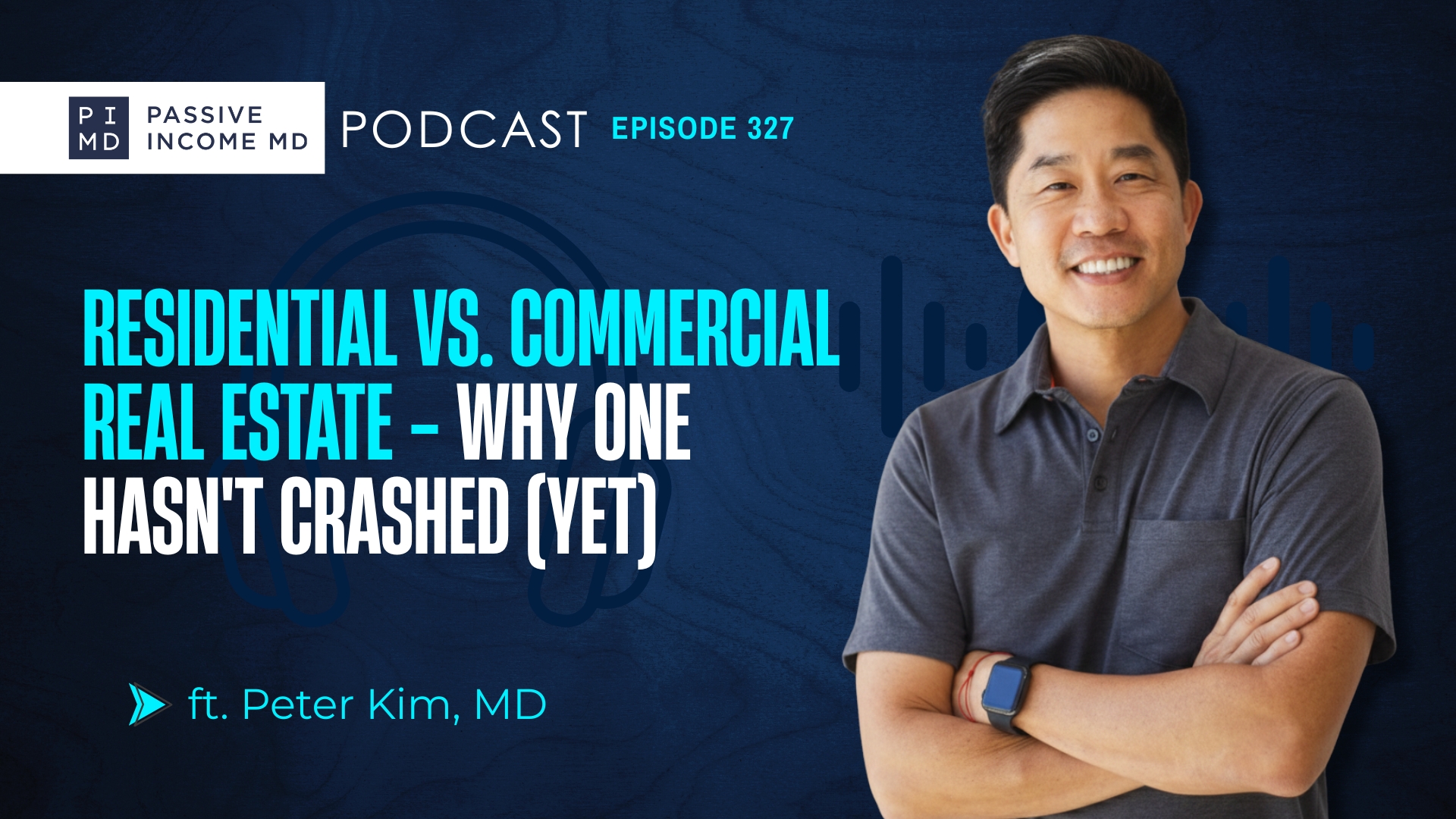
#327 Residential vs. Commercial Real Estate – Why One Hasn’t Crashed (Yet) ft. Peter Kim, MD


Episode Highlights
Now, let’s look at what we discussed in this episode:
- A Friend’s Question About Real Estate Prices
- What’s Actually Happening with Home Prices
- Why Commercial Real Estate Plays by Different Rules
- The Perfect Storm Hitting Commercial Deals
- Where the Next Opportunity Comes From
Here’s a breakdown of how this episode unfolds.
Episode Breakdown
A Friend’s Question About Real Estate Prices
Peter opens with a conversation he had with a physician friend, who pointed out that real estate must be doing fine since prices haven’t crashed. His friend even mentioned homes in his neighborhood still getting offers over asking. Peter agrees his friend isn’t wrong about what he’s seeing, but says he’s only looking at half the picture.
He explains that residential real estate has genuinely held up well, but commercial properties like apartment buildings, retail, and office space are going through a completely different cycle right now, even under the same interest rate environment. That contrast is the whole reason for this episode.
Peter frames the core idea simply: real estate isn’t one single market, it’s several different markets that all happen to share the same name. Understanding why residential and commercial are behaving so differently is what most people, including his friend, tend to miss.
What’s Actually Happening with Home Prices
Peter breaks down the actual numbers behind residential real estate as of June 2026. Home prices rose 0.3% month over month and are up 3% year over year, with the median existing home price sitting around $440,000. He points out that a lot of people have been predicting a crash for years, but a crash requires way more supply hitting the market than demand can absorb, and that’s simply not what’s happening.
There are about 1.5 million homes for sale right now, only slightly up from a year ago, which works out to roughly 4 to 5 months of supply, basically unchanged. He also addresses headlines about foreclosures jumping over 20%, which sounds alarming until you compare the actual number, about 227,000 in the first half of this year, to the 1.65 million foreclosures during the same period back in 2010. He adds that natural disasters like fires remove roughly 300,000 homes from the market every year, inventory that rarely gets talked about.
He also covers mortgage rates, currently around 6.6% on the 30-year fixed, tracking closely with the 10-year Treasury. He walks through how rates climbed from under 2% in early 2022 to over 4.6% as inflation took off, with the Iran conflict adding more pressure through rising energy prices. His bottom line is that residential rates have been stuck in a stable 6 to 8% range for four years, not collapsing and not spiking dramatically either.
Why Commercial Real Estate Plays by Different Rules
This is where Peter gets into what his friend wasn’t seeing. Commercial loans don’t work like a standard 30-year fixed mortgage. Many commercial deals, especially value-add multifamily syndications, were financed with floating rate loans that run short term, usually 3 to 5 years, with the plan to refinance or exit once the term ended.
He explains the mechanic that actually breaks these deals: when that loan comes due, the entire remaining balance is owed all at once, not spread out like a monthly payment. This is called a balloon payment. On top of that, many of these loans carry prepayment penalties that home mortgages typically don’t have, meaning even sponsors who saw trouble coming couldn’t easily exit early without eating a significant cost.
Peter is upfront that he’s not just watching this from the outside, he’s been an active investor in some of these deals himself. He points out that nobody, including institutional players managing billions and operators with decades of experience, underwrote for rates rising this fast and staying elevated this long. He frames it less as a due diligence failure and more as a set of conditions nobody had really modeled for.
The Perfect Storm Hitting Commercial Deals
Peter lays out the tight spot sponsors find themselves in once a loan comes due. They basically have three options: refinance, sell, or find the cash some other way. Refinancing is harder now because higher rates mean lenders will only lend a smaller percentage of the property’s value compared to a few years ago. Selling isn’t much better either, since commercial property values move with interest rates and often means locking in a loss.
That usually leaves one path, which is bringing in fresh capital that nobody originally planned on spending. Peter explains why this hit at the worst possible time. Rates went up, insurance and operating costs climbed too, rent growth slowed because renters simply can’t absorb higher costs, and a wave of new multifamily supply built during the low rate years is now landing in an already soft market.
He sums it up as several pressures converging at once, rate resets, rising costs, a ceiling on rents, and new supply flooding in simultaneously. That combination is what created what he calls the perfect storm hitting commercial real estate specifically, even while residential holds steady right next to it.
Where the Next Opportunity Comes From
Reinvention Without Leaving Medicine YOU KNOW ALL TOO WELL THAT ENTREPRENEURSHIP CAN BE A LONELY BUSINESS.
If you are looking for a private, invitation-only Mastermind designed for physicians and high-performing professionals who will settle for no less than fulfilling their visions of success while helping others do the same — Momentum MD is for you!
Filling our next cohort now, limited spots are available! APPLY now!