
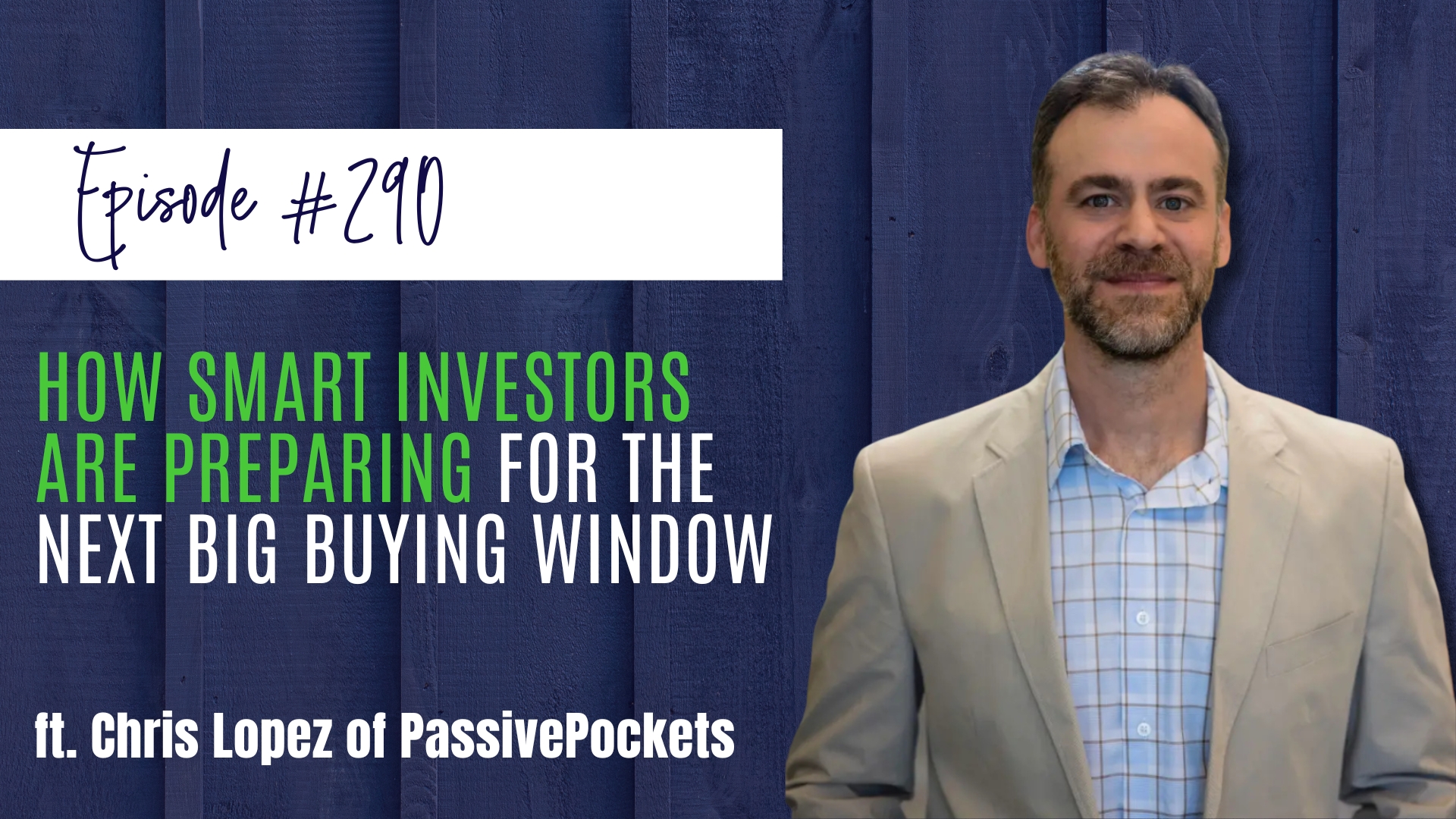
#290 How Smart Investors Are Preparing for the Next Big Buying Window ft. Chris Lopez of PassivePockets


Episode Highlights
Now, let’s look at what we discussed in this episode:
- Chris’s Early Journey Into Real Estate
- Learning Through Trial and Error
- Choosing Passive Investing for Time and Family
- Using ROE to Decide If a Property Still Works
- Opportunities Ahead and First Steps for New Passive Investors
Here’s a breakdown of how this episode unfolds.
Episode Breakdown
Chris’s Early Journey Into Real Estate
Peter opens the conversation by introducing Chris Lopez, a Denver based investor and entrepreneur. Chris is the co host of the Passive Pockets podcast and the founder of Property LLaMA Capital. Peter points out that Chris started on the active side of real estate, then eventually shifted into passive investing. Chris explains that he originally went to Virginia Tech to become an engineer, but quickly realized engineering was not a good fit.
During this period, Chris read Rich Dad, Poor Dad, which completely changed how he viewed money, business, and investing. He became very interested in real estate but did not have the resources that exist today. There was no YouTube University, no big online communities, and very little accessible education. So he decided to first focus on making money through internet marketing, since the early 2000s were a time when the internet was just beginning to grow quickly.
He built a successful online marketing business and later tried day trading, but found that he hated it and was not very good at it. When the 2008 financial crisis hit, his business faced headwinds, and he saw real estate prices dropping. That was the moment he decided it was time to finally get into real estate. Around 2010 he began shifting his focus toward buying properties and starting a new business in the real estate space, which led to his very first investment deal.
Learning Through Trial and Error
Chris describes his first real estate purchase, a condo in Reno that he bought around late 2010, closing in early 2011. The property had been worth more than 200,000 dollars a few years earlier, but he bought it for about 67,000 dollars as a foreclosure. Financing was tight at the time, so he started talking to people about what he wanted to do and the problems he was running into. Through those conversations, a private investor offered him a zero down, 15 year fixed loan at five percent, which allowed him to buy the property with no money out of pocket.
Peter then asks how Chris was able to push through the fear that often stops high achieving professionals from acting. Chris explains that his mindset focused on risk versus consequence. His wife is a veterinarian, and he compares her surgery days, where mistakes can have serious consequences, to his world of marketing, business, and real estate. In his case, the worst outcome was usually losing some money or time, not losing a life or destroying his family finances. If the downside did not include getting sued, going bankrupt, or losing his home, he considered the risk acceptable.
He also shares that people see the highlights, such as becoming a real estate investment broker and completing hundreds of millions of dollars in transactions, but they do not see the four years of “eating dirt” in between. He tried flipping, made money, but hated it. He worked as a junior multifamily broker and realized that cold calling all day did not use his online marketing strengths. He attempted to copy a high volume flipper using internet marketing and got crushed. Each attempt taught him something and eventually guided him into a role where his skills in finance, marketing, and real estate all worked together.
Choosing Passive Investing for Time and Family
By 2019, Chris had built a solid rental portfolio and his brokerage business was doing very well. At the same time, he and his wife had their second child, and he began to feel the strain on his time and energy. Market conditions were also changing. Prices had climbed, rents were not rising as fast, and interest rates were drifting upward even before COVID. For the amount of effort he was putting into light value add projects, the returns no longer felt worth his time.
He decided to test passive investing by writing a small check into a multifamily value add deal as a limited partner. He wanted to see what it would be like to let someone else operate the asset. After a year, he noticed that the returns were as good or better than his rentals, and he had done no work. This experience opened his eyes. He still bought a few more rentals after that, but he started investing more and more as an LP and eventually stopped buying rentals altogether around 2021 or 2022.
The hardest part of this transition was giving up control. Active investors like to be in charge of the details. Chris worked through that mindset by looking at the reality. Large multifamily requires big teams, with full asset management, construction, and property management operations. He realized he did not want to run that type of company. Instead, he focused on finding strong operators he knew through his Denver network, people whose teams and track records he trusted. Once he accepted that they could execute better at scale, it became easier to lean into passive investing, sell some rentals, and even use self directed retirement accounts to invest in passive deals.
Using ROE to Decide If a Property Still Works
Peter brings up a concept Chris talks about often, which is return on equity. Chris explains that many investors stay focused on return on investment based on their original down payment. That works for the first couple of years, but after three or four years, the picture changes. The mortgage gets paid down, the property often appreciates, and a lot of equity builds up. Return on equity asks a different question. It looks at how well that equity is performing right now.
He uses his first Reno condo as an example. Because he bought it with zero down, his return on investment looked infinite on paper. After several years, the condo had around 200,000 dollars in equity and was producing about 2,000 dollars a month in cash flow. When he added up cash flow, appreciation, and principal paydown as a percentage of that 200,000 in equity, the return on equity was around seven percent. A mentor then pointed out that the long term historical return of the stock market is roughly ten percent, which meant his condo was actually underperforming a simple index fund.
That comparison stuck with him. He realized that he needed to regularly evaluate properties based on current equity, not on what the deal looked like years ago. He outlines three options for a low ROE property. First, keep it and optimize income and expenses, but there are limits to that. Second, do a cash out refinance, but only if it does not push the property into negative cash flow. Third, sell and recycle the equity. In his case, he sold the condo in a 1031 exchange, bought a fourplex, and increased both his cash flow and his ROE significantly. This framework helps investors decide whether their equity should stay where it is or be moved into something better.
Today’s Market and How to Start Passively
As the conversation shifts toward the current market, Chris explains that most single family markets are not distressed, but parts of the multifamily world are starting to show real stress. For the first time in years, he has seen banks forcing multifamily properties to market. He believes we are in an early phase of a distressed cycle in that space, similar in feeling to about 2009 for single family homes. That could create good buying opportunities for well prepared investors over the next few years.
He has personally shifted more toward Class A type assets and toward income focused vehicles such as debt funds and preferred equity. These tend to sit in safer parts of the capital stack and can still provide double digit returns with strong cash flow. In his view, many physicians and other high income professionals are mostly looking for reliable additional income, so they can choose whether to work extra shifts or take more time off. Cash flow focused investments can directly support those lifestyle decisions.
For someone just starting out with passive investing, Chris suggests beginning with clarity on goals, risk tolerance, and family priorities. Then, as a tactical first step, he often recommends looking at diversified debt funds, which spread risk across many loans and usually start paying cash flow within a few months. He encourages new investors to plug into trusted communities, review many deals before choosing one, and set a concrete goal, such as writing one check within 100 days after doing proper due diligence. His final advice is to be intentional, study multiple deals, and build confidence through repetition, since that is how investors learn to tell a good deal from a bad one.
YOU KNOW ALL TOO WELL THAT ENTREPRENEURSHIP CAN BE A LONELY BUSINESS.
If you are looking for a private, invitation-only Mastermind designed for physicians and high-performing professionals who will settle for no less than fulfilling their visions of success while helping others do the same — Momentum MD is for you!
Filling our next cohort now, limited spots are available! APPLY now!