
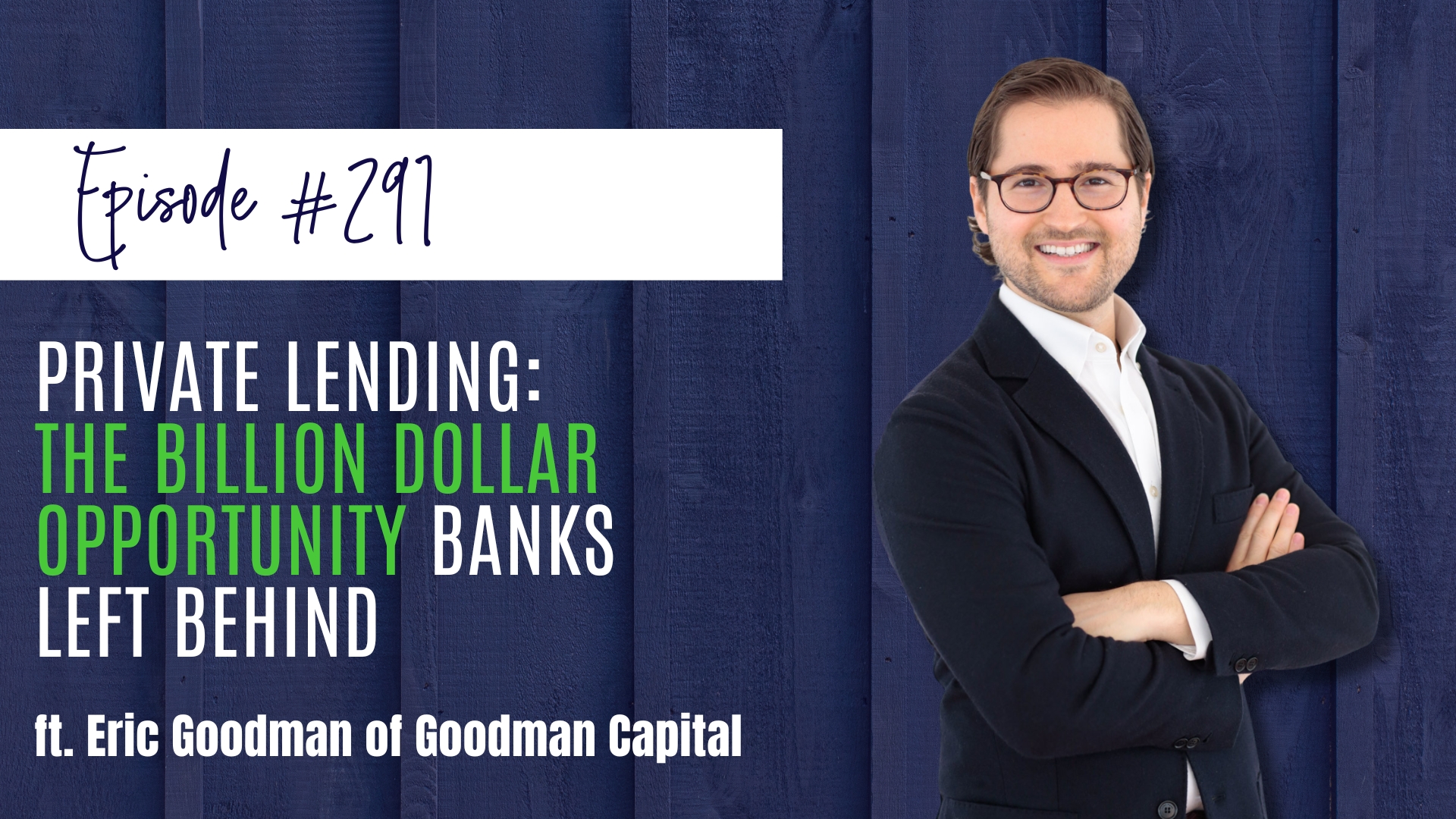
#291 Private Lending: The Billion Dollar Opportunity Banks Left Behind ft. Eric Goodman of Goodman Capital



Episode Highlights
Now, let’s look at what we discussed in this episode:
-
What Private Credit Is and How Goodman Capital Started
-
How Goodman Capital Adjusted to the New Market
-
How Risk, Defaults, and Foreclosures Work
-
What Investors Should Ask Before Investing
-
Where the Opportunity Is and Advice for Investors
Here’s a breakdown of how this episode unfolds.
Episode Breakdown
What Private Credit Is and How Goodman Capital Started
Peter opens the episode by introducing Eric Goodman, whose family has been lending in real estate since 1987. Goodman Capital grew alongside the Northeast real estate markets and survived many cycles. Eric explains that private credit simply means lending that happens outside traditional banks. Today the term is widely used, but years ago it was labeled “shadow banking” because banks viewed it negatively.
Eric breaks down the history. Before the 2008 financial crisis, banks were heavily involved in bridge loans and similar lending. After that crisis, new regulations pushed banks out. Private lenders stepped in to take their place. Then the 2023 banking crisis changed everything again. Large regional banks such as Signature and First Republic failed, and many high-net-worth borrowers lost their private banking relationships. This opened a massive space for experienced private lenders.
Eric notes that the collapse of these banks will likely shape the market for decades. Borrowers who used to rely on bank relationships now depend on private lenders. This shift has significantly increased the demand for firms like Goodman Capital.
How Goodman Capital Adjusted to the New Market
Eric explains that higher interest rates and a sudden disappearance of banks created two main borrower groups. One group consists of high-quality borrowers who used to receive low-rate loans from banks but no longer can. The second group consists of borrowers who are struggling with rising rates and now face much more expensive private debt.
Goodman Capital chose to focus on the strongest borrowers in the market. These borrowers own Class A real estate, have significant financial resources, and are comfortable with low leverage. They are willing to pay 10 to 11 percent because the alternative is paying 14 to 15 percent from higher-risk lenders. Eric emphasizes that their company does not chase risky loans. They stay conservative and take on borrowers that banks once served.
Because so many regional banks collapsed, there is very little competition in the range of loans that Goodman Capital provides. These are typically loans from roughly 5 million to 50 million dollars. Eric believes this opportunity will last for many years because it takes a long time for banks to return to the market.
How Risk, Defaults, and Foreclosures Work
Peter asks Eric to explain how risk works in simple terms. When borrowers pay monthly interest, those payments go to investors. Most loans last about one year. The key question is what happens when a borrower does not pay on time.
Eric uses a real example. A foreign national bought a 14 million dollar Manhattan townhouse in cash and then sought a 6 million dollar refinance. This is a low loan-to-value deal and a very strong borrower. Normally, borrowers like this pay every month. If they do not pay off the loan at maturity, that is called a maturity default. When this happens, Goodman Capital steps in immediately. Their team spent more than twenty-five years working only in distressed debt. They handled foreclosures and complex legal processes long before launching their current funds.
Because everything is done in-house, their team can act fast. They send notices, accelerate the loan, and file foreclosure paperwork without waiting for outside law firms. Even in New York, which uses a judicial foreclosure system, they usually recover principal within twelve to eighteen months. Eric’s main point is simple. Their experience in distressed debt protects investors today. Over thirty-eight years, they have never lost investor principal.
What Investors Should Ask Before Investing
Peter asks what questions investors often forget to ask. Eric begins with the most important one. How long has the firm been doing this work? Many private credit companies appeared in the last few years because high interest rates made returns look exciting. A firm that has never lived through a cycle or a foreclosure may not know how to manage real risk.
Another key question is where the firm lends. Different states have very different rules. Some are judicial and some are non-judicial. Property values behave differently from region to region. When lenders lose money, it is usually because they overestimated the value of the property. If the loan is too large and the firm must foreclose and sell the property for less, investors lose principal. This means conservative underwriting is essential.
Eric also advises investors to ask about transparency. Do they have audited financials? Do they use a third-party administrator? How many people are on the team? Are they lending senior debt or higher-risk debt? These questions reveal whether a lender is built to manage risk or simply built to collect investor capital.
Where the Opportunity Is and Advice for Investors
Eric talks about the future of private credit. Falling interest rates by themselves do not change the landscape very much. The real change is the lack of competition. Banks are being pushed away from real estate lending and into business lending. This leaves private lenders as the main source of capital for many borrowers. Goodman Capital sees roughly fifteen billion dollars in deal flow each year, and they approve only a small percentage after underwriting.
Peter asks who private credit is best for. Eric shares a personal story. His youngest investors are his children, and his oldest is his ninety-five-year-old grandmother. Private credit works for both groups because it provides consistent income, low volatility, and strong downside protection. In a world where many investments are unpredictable or do not produce income, private credit can be a stabilizing force.
Eric ends with a simple piece of advice. Do not chase the highest returns. High teen interest rates usually come with high risk to principal. In the current environment, earning 10 to 11 percent while lending at low leverage on high-quality properties is already an excellent deal. Focus on risk-adjusted returns, not flashy numbers. That is how to build long-term stability during uncertain markets.
YOU KNOW ALL TOO WELL THAT ENTREPRENEURSHIP CAN BE A LONELY BUSINESS.
If you are looking for a private, invitation-only Mastermind designed for physicians and high-performing professionals who will settle for no less than fulfilling their visions of success while helping others do the same — Momentum MD is for you!
Filling our next cohort now, limited spots are available! APPLY now!