
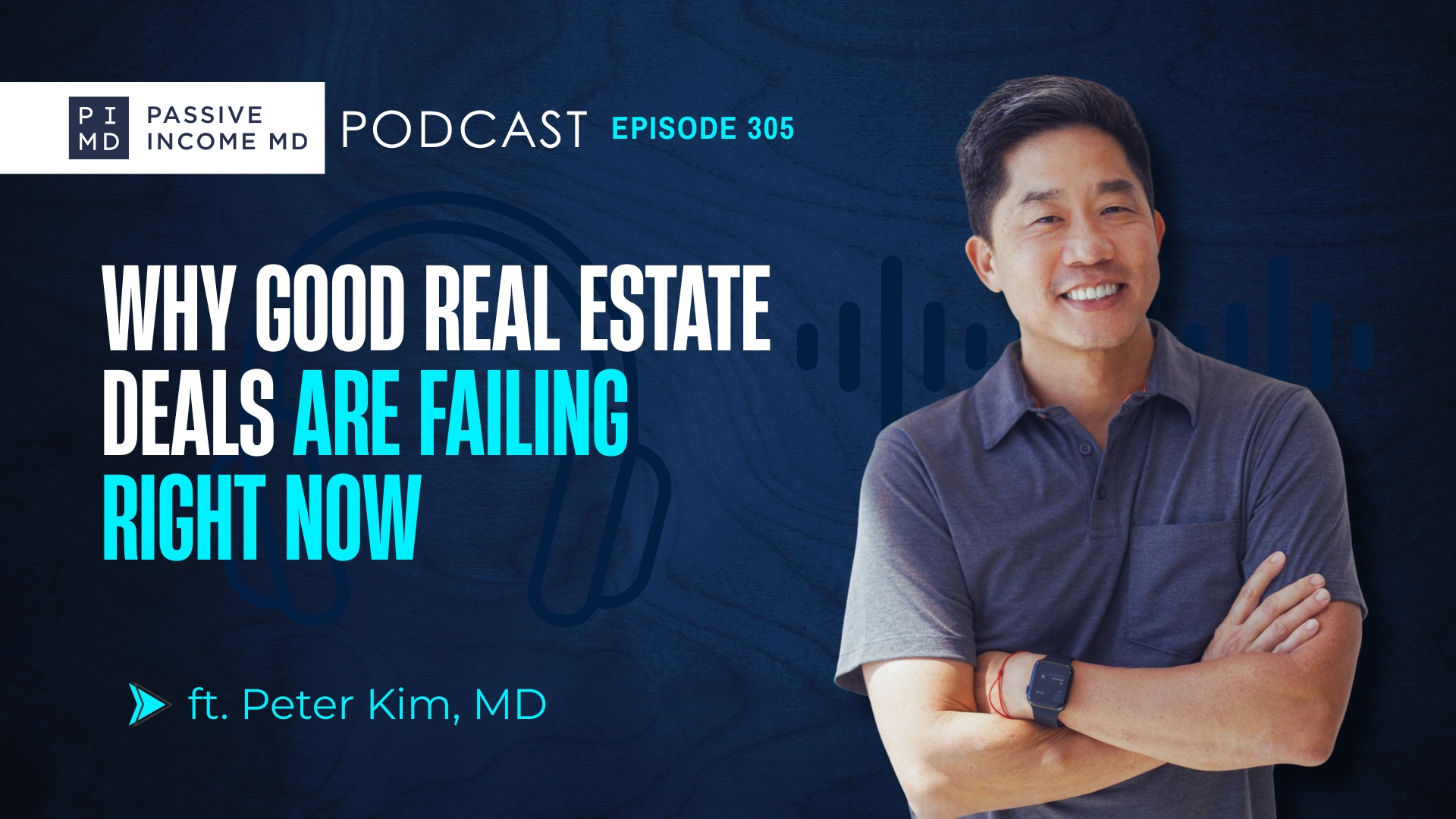
#305 Why Good Real Estate Deals Are Failing Right Now ft. Peter Kim, MD


Episode Highlights
Now, let’s look at what we discussed in this episode:
- Real Estate Deals: Confusion Among Investors
- The Importance of Debt in Real Estate Deals
- Bad Deals vs. Fragile Deals
- The Role of Loans and Banks in Real Estate Failures
- Surviving Real Estate Cycles: Playing the Long Game
Here’s a breakdown of how this episode unfolds.
Episode Breakdown
Real Estate Deals: Confusion Among Investors
Peter opens by addressing a common feeling among investors, especially physicians, who are either already invested in real estate or considering new deals. While there is no panic, many are confused about why their investments aren’t performing as expected.
Despite solid properties, good occupancy, and seemingly favorable market conditions, investors are seeing issues like slowed distributions or returns that don’t match projections. Peter reassures listeners that this confusion is widespread and not a sign of poor decision-making. The root cause is not the property itself, but rather the debt associated with the deal.
The Importance of Debt in Real Estate Deals
Peter explains how debt plays a crucial role in real estate investments. While properties are typically seen as long-term assets, many loans used to finance them are short-term, especially in commercial real estate.
Short-term loans can work well in an environment of low interest rates and easy refinancing, but as Peter points out, when interest rates rise or refinancing options become limited, these loans can become a serious burden.
This is what’s happening to many deals today: rising debt costs are harming the financial viability of properties that seemed solid at first glance. Understanding how these loans function is key to recognizing the risks involved in real estate investing.
Bad Deals vs. Fragile Deals
Peter introduces the distinction between “bad” deals and “fragile” deals.
A “bad” deal is fundamentally flawed from the start, while a “fragile” deal can appear solid but is vulnerable to external factors, such as low-interest rates or continuous property appreciation. When these assumptions fail, the deal doesn’t bend but breaks.
The current market cycle has exposed many such fragile deals. Peter underscores the need for investors to recognize that fragility in deals, often stemming from reliance on external conditions, can lead to significant issues when the market changes.
The Role of Loans and Banks in Real Estate Failures
Peter explains that while real estate is a long-term asset, many real estate loans are short-term in nature, particularly in commercial real estate.
These loans often come with terms of three to five years, and their success depends on the ability to refinance or extend the loan. However, when the loan comes due, the bank doesn’t care about the property’s performance or how much work the operator has done to improve it.
The bank simply wants repayment, which can lead to major problems if refinancing isn’t available. This serves as a crucial reminder that investors need to understand the risks tied to debt and how loan terms can impact the success of a real estate deal.
Playing the Long Game in Real Estate Cycles
YOU KNOW ALL TOO WELL THAT ENTREPRENEURSHIP CAN BE A LONELY BUSINESS.
If you are looking for a private, invitation-only Mastermind designed for physicians and high-performing professionals who will settle for no less than fulfilling their visions of success while helping others do the same — Momentum MD is for you!
Filling our next cohort now, limited spots are available! APPLY now!