
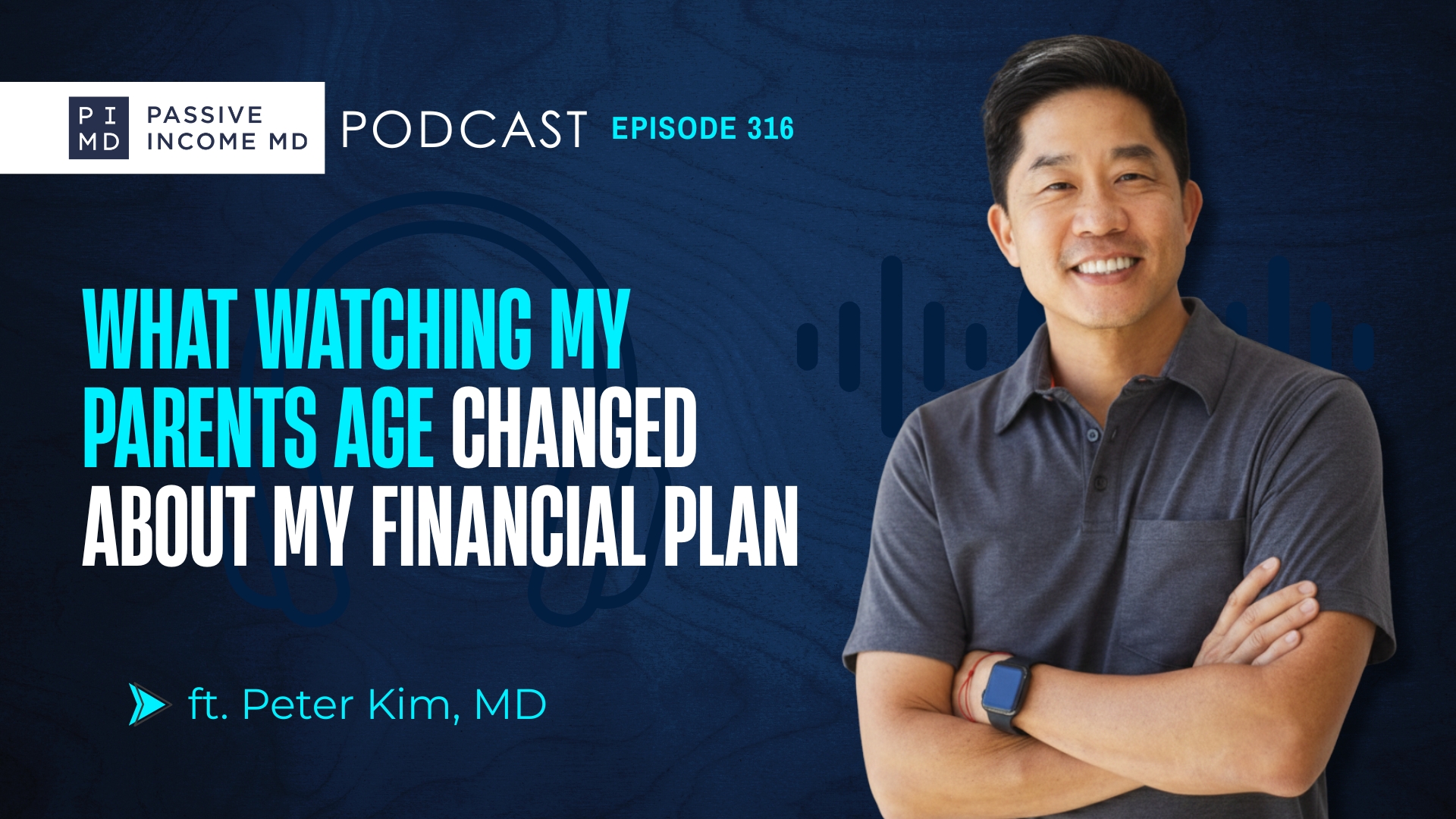
#316 What Watching My Parents Age Changed About My Financial Plan ft. Peter Kim, MD


Episode Highlights
Now, let’s look at what we discussed in this episode:
-
The Financial Reality Nobody Prepares You For
-
What This Changed About How Peter Thinks About Liquidity
-
Why Passive Income Matters More Than Peter Expected
-
The Trip His Father Changed His Mind About
-
What You Can Actually Do Right Now
Here’s a breakdown of how this episode unfolds.
Episode Breakdown
The Financial Reality Nobody Prepares You For
Peter opens by admitting something he hasn’t really talked about on the podcast before. Watching his parents deal with health challenges over the last couple of years has exposed a gap in his financial thinking that no course, book, or advisor ever addressed. On paper, things look fine. But living through it is a completely different experience.
He points out that most physicians plan for their own retirement but almost nobody plans for what it costs to help their parents as they age. Memory care alone can run anywhere from $6,000 to $20,000 a month. In-home care with a full-time aid costs in the same range. And this isn’t a short-term situation. It can go on for years. Medicare doesn’t cover most of it, and the long-term care policies that people do have often don’t come close to what care actually costs today.
That gap tends to fall on whoever in the family is most capable of handling it, which for most listeners is the physician. Peter also brings up something that doesn’t get talked about enough: the time cost. Coordinating care, managing providers, navigating insurance, being the point of contact for every decision, it functions like a part-time job. And it tends to show up right when you’re at your professional peak, right when your own kids need you most, and when you have the least margin to give.
What This Changed About How Peter Thinks About Liquidity
The first thing Peter says watching his father’s health decline changed was how he thinks about liquidity. He used to approach it the standard way: a few months of expenses, an emergency fund, and that’s enough. But what he didn’t account for is that the situations that drain you the most aren’t always dramatic emergencies. They’re slow. A parent’s health declining over two or three years doesn’t feel like a crisis on any given day, but the costs and the decisions accumulate.
If your capital is locked up in retirement accounts or illiquid assets, you may not have the flexibility to respond when you actually need to. That stress is real. Peter says having accessible cash mattered more than he had given it credit for, and he thinks a lot of physicians are underliquid relative to where they actually are in life. Net worth looks fine on paper, but how much of it can you actually get to right now without a penalty or a major tax event?
He’s not saying retirement accounts are a bad idea. He still contributes to his. But the mental model of “just accumulate until 65 and then access it” breaks down when life doesn’t wait until 65. Supporting a parent in your late 40s or early 50s, while most of your capital sits behind an age threshold, is a real situation that a lot of physicians aren’t prepared for.
Why Passive Income Matters More Than Peter Expected
The second shift in Peter’s thinking has to do with income. Physicians are disciplined savers. They max out 401(k)s, they defer gratification, they build balances over time. But the model of just accumulating and waiting until retirement age breaks down in exactly the kinds of situations he’s describing. When you need to step away from work to care for a parent, or even just take time to be present with family, income tied to your hours is a problem.
The physicians Peter has watched navigate this season most cleanly, his word, had income coming in that wasn’t tied to showing up. When they needed to take a week to handle a parent’s care or be with family, it didn’t cost them a week’s pay. Or if it did cost them, they had income coming in from other sources that softened the impact. That’s not a luxury. It’s a form of financial flexibility that doesn’t show up as a number on a spreadsheet but makes an enormous difference when life gets complicated.
This is the part where Peter connects the whole conversation back to the passive income theme of the podcast. Building income that doesn’t require you to be present isn’t just about getting rich or retiring early. It’s about having options when something unexpected happens. And in the context of aging parents, something unexpected happening is basically guaranteed.
The Trip His Father Changed His Mind About
The third thing Peter shares is the most personal. His father is turning 78 this year. They took some trips together recently, including a few bucket list items, and during one of those trips his father said to him: “You’re lucky. Take advantage of these times, because you’ll be wishing for more of them when you get to my age.” Peter says hearing that from his own parent hit differently than hearing it from anywhere else.
He talks about a version of financial planning that treats experiences as things you earn later. Travel when you’re retired. Slow down once the mortgage is paid off. He doesn’t believe in that anymore. Health changes, mobility changes, and you don’t always get a warning. The window when your parents are still healthy enough to travel, your kids still want to be around you, and everyone is in good enough shape to actually enjoy it, that window is real and it is finite.
What he landed on is this: build the trips into the plan now. Not as a reward for hitting some financial milestone, but as a priority. He frames it not as a motivational message but just as something that’s true. You don’t know when that window closes, so treat it like it matters while you still have it.
What You Can Actually Do Right Now
Reinvention Without Leaving Medicine YOU KNOW ALL TOO WELL THAT ENTREPRENEURSHIP CAN BE A LONELY BUSINESS.
If you are looking for a private, invitation-only Mastermind designed for physicians and high-performing professionals who will settle for no less than fulfilling their visions of success while helping others do the same — Momentum MD is for you!
Filling our next cohort now, limited spots are available! APPLY now!