
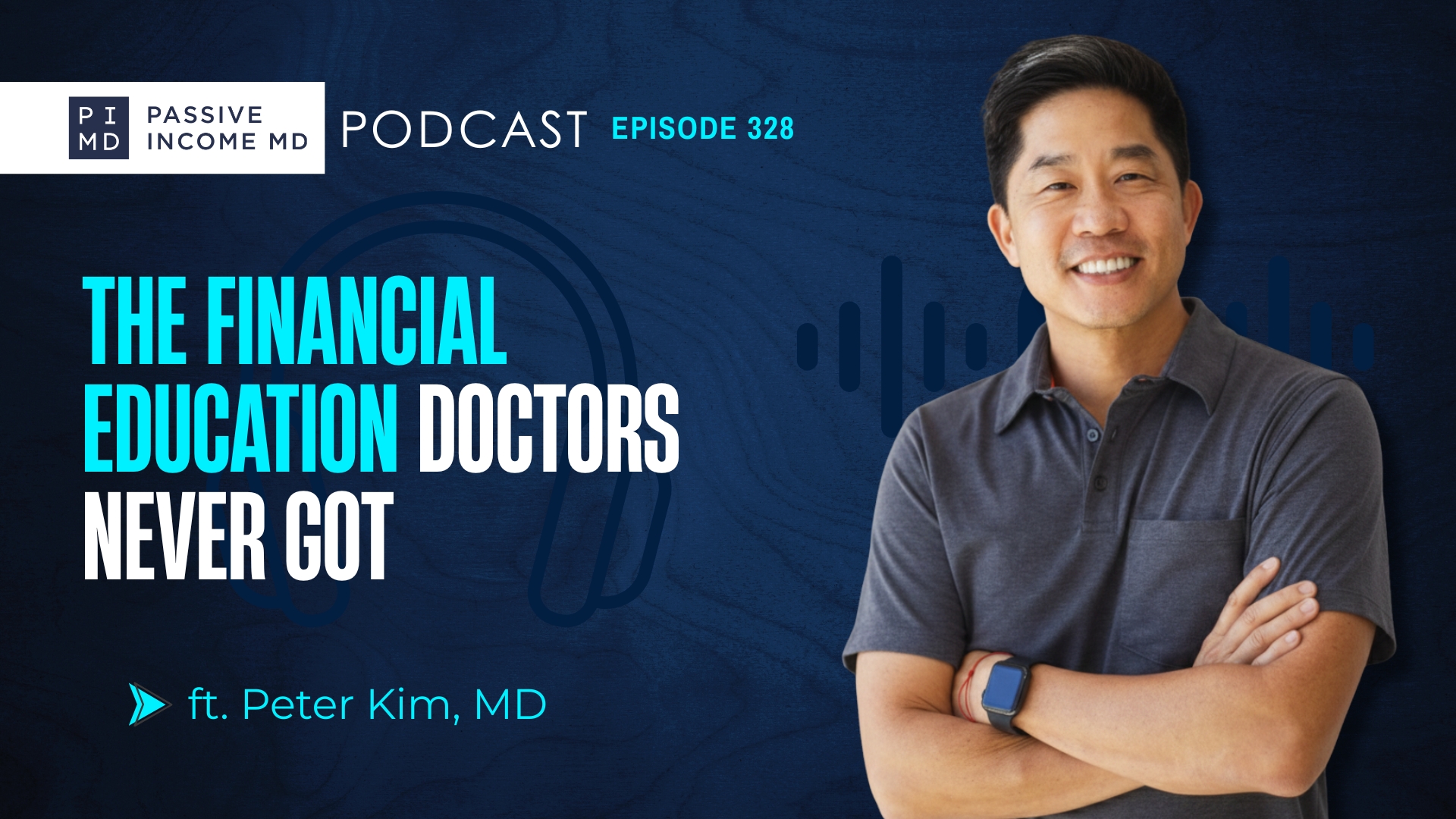
#328 The Financial Education Doctors Never Got ft. Peter Kim, MD


Episode Highlights
Now, let’s look at what we discussed in this episode:
- A Question Nobody Could Answer
- Why the Gap Exists
- More Access Than Any Generation Before
- The Four Places Peter Actually Learns
- The Responsibility Is Also the Opportunity
Here’s a breakdown of how this episode unfolds.
Episode Breakdown
A Question Nobody Could Answer
Peter opens with a thought experiment: if someone handed you $10,000 a month with no strings attached, would anything about your life actually change? He connects this to a panel he sat on with two other physicians, where the moderator asked a simple question, where did they get their financial education. Every single person on that panel gave the same answer, they never got any formal training in it, not in high school, college, med school, or residency.
That moment got Peter thinking about how much personal finance quietly shapes a physician’s entire career, from how many patients they see to whether they take a real vacation or just check messages from the beach. He argues that most of these decisions trace straight back to the numbers, and almost none of us were ever taught how to actually run those numbers.
He frames the rest of the episode around three things: why this gap exists, why it genuinely isn’t anyone’s individual fault, and what he’s personally done to close it in his own life.
Why the Gap Exists
Peter digs into why physicians never get this training in the first place. He points to a University of Michigan Medical School survey where students only answered a little over a third of basic personal finance questions correctly, while nearly 90 percent said they wished they’d received financial literacy training. A separate survey of residents found that most had never had any personal finance education heading into their training at all.
He’s careful to frame this as structural rather than a personal failure. Physicians spend years studying subjects like calculus and organic chemistry, which he jokes he’d struggle to help his own kid with today, while something far more practical like reading a profit and loss statement or building a real budget never makes it into the curriculum.
He briefly floats the idea that maybe some industry benefits from people not understanding their own money, but pulls back from that theory pretty quickly. His actual take is more mundane: nobody was ever specifically assigned the job of teaching this, and the incentives never pushed hard enough to fix it.
More Access Than Any Generation Before
Peter shifts the conversation from what went wrong to what’s actually possible today. He points out that physicians right now have more access to financial education than any generation before them. The old gatekeeping, where you needed an advisor or a paid seminar just to learn the basics, has largely disappeared.
Between AI tools, YouTube, and online communities full of people working through the exact same problems, Peter says there’s more free, high quality information available today than most financial advisors even had access to a few decades ago. He’s upfront that when people ask where he learned all this, there’s no secret pipeline or private resource he’s not telling anyone about.
This sets up the rest of the episode, where he breaks down exactly where he personally goes to learn, treating it less like a random list and more like a repeatable framework anyone could follow.
The Four Places Peter Actually Learns
Peter walks through his four main sources of financial education. The first is online research, including AI tools, which he uses constantly but never takes at face value. He’s clear that AI and search results deliver answers confidently even when they’re wrong, so he treats anything he learns there as a starting point that still needs to be checked against other sources.
Second is social media and YouTube, which he uses more for staying current on specific topics than for structured learning. Third is books, and he specifically mentions returning again and again to The Psychology of Money and Die With Zero, not for tactics, but because they change how he actually thinks about money in the first place. Fourth, and the one he thinks people underrate the most, is events and community, being physically around people who are a step or two ahead and doing things differently.
He acknowledges this can sound like a lot to add to an already packed schedule, but points out it doesn’t require carving out free time you don’t have. It’s swapping music for a podcast on the drive to work, or reading something useful for half a flight instead of scrolling. If you’re listening to this episode right now, he says, you’re already doing exactly that.
The Responsibility Is Also the Opportunity
Reinvention Without Leaving Medicine YOU KNOW ALL TOO WELL THAT ENTREPRENEURSHIP CAN BE A LONELY BUSINESS.
If you are looking for a private, invitation-only Mastermind designed for physicians and high-performing professionals who will settle for no less than fulfilling their visions of success while helping others do the same — Momentum MD is for you!
Filling our next cohort now, limited spots are available! APPLY now!