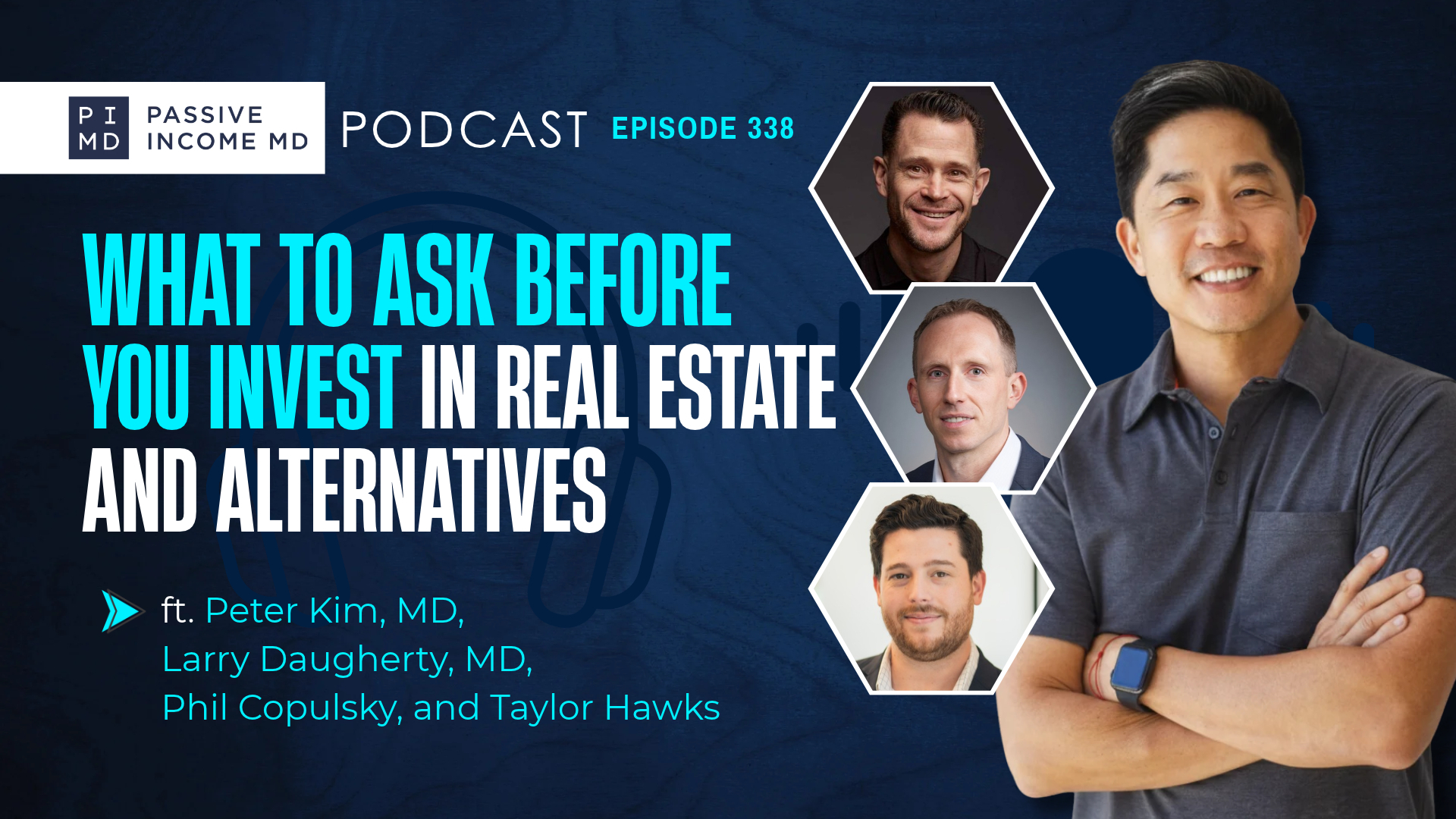
#338 What to Ask Before You Invest in Real Estate and Alternatives ft. Dr. Peter Kim, Dr. Larry Daugherty, Phil Copulsky, and Taylor Hawks



Episode Highlights
Now, let’s look at what we discussed in this episode:
- Is Real Estate Still Worth It? Meet the Panel
- What Alternatives Are, and Active vs Passive vs Debt
- The Market Reset and Where the Opportunity Is
- Where to Learn, and Why Community Beats Information
- The One Question to Ask Before You Invest
Here’s a breakdown of how this episode unfolds.
Episode Breakdown
Is Real Estate Still Worth It? Meet the Panel
Peter opens by saying one of the questions he heard most at PIMDCON this year wasn’t about any specific deal, it was whether real estate is still worth it right now. He calls it a fair question. Rates aren’t where they’re supposed to be, and some deals from the last cycle didn’t go the way anyone hoped, including a couple he’s been part of. So he wanted to put the question to people who are actually looking at and operating deals, not just talking about them.
This conversation comes from Encore Nights, the virtual sessions PIMD ran the week after the conference. Peter lays out what’s coming: what’s working in real estate right now, how to think about alternatives beyond real estate, and the honest version of what passive income looks like once you’ve been doing it for a while. He introduces Dr. Larry Daugherty, a part time radiation oncologist, five time Iditarod musher, and Everest summiter with a personal portfolio of more than 200 units. Next is Phil Copulsky, Vice President of Capital Formation at Revere Capital, who has also worked at big institutions like Goldman Sachs. Then there’s Taylor Hawks of Aspen Funds, who comes from private equity, has overseen more than $100 million in transaction volume, and specializes in deal structure.
Each guest then shares what excites them most about their work. Larry talks about sharing adventure with others, including leading a group of physicians up Mount Kilimanjaro in 2027 and the Basecamp group where they learn real estate and also walk through life together. Phil explains that Revere focuses on commercial real estate lending, and he enjoys educating investors about what the debt side offers in passive income and margin of safety.
Taylor says Aspen Funds is an alternative investment firm working in commercial real estate and oil and gas, and what he enjoys most is hearing people’s stories, like an hour long breakfast conversation at PIMDCON that had almost no investment talk.
What Alternatives Are, and Active vs Passive vs Debt
Peter asks Taylor to explain why they’re called alternatives. Taylor says it’s pretty much the same as private markets. You have the public market and then the private market, which includes alternatives, things you can own privately or personally like real estate, business acquisitions, and mineral rights, where a stock market isn’t dictating the price. Larry then shares his path, which started at PIMDCON in 2019.
Three months later he bought his first fourplex. He’s been on the active side, buying himself, starting with duplexes and fourplexes and growing to a 70 unit building and a couple hundred units across Alaska. His rule from day one is that a property has to cash flow at purchase, and he met his goal of replacing his physician salary in three years.
Phil explains the debt side. Owners often use debt to buy real estate, and as the lender, Revere sits in a first lien position, meaning if a borrower defaults they can take over the property. He’s clear that isn’t what they want, since it means something went wrong along the way. What they’re after isn’t the upside, it’s consistent cash flow and getting repaid when the loan comes due.
When Peter asks how someone figures out what fits them, Taylor starts with active versus passive. You can own and manage the property yourself, or put discretionary income into something like Aspen’s limited partnership model and keep your day job. He adds that goals matter too, whether you want current income to step back from your W-2 or longer term equity with a big payday 15 or 20 years out. Phil adds that you need to know your risk tolerance, your stomach for volatility in public markets and your comfort with illiquidity in private ones.
Larry says active investing offers the highest returns and best tax benefits if you’re willing to invest the time, but it’s not for you if you dread buying and managing real estate. Passive investors still need to know how to vet a deal, because they have less control once the money is with an operator.
The Market Reset and Where the Opportunity Is
Peter asks what the panel is seeing in the market and where the opportunity is. Phil gives some history. Since the 2008 financial crisis, rates were pushed down artificially, and the 2012 JOBS Act made it easy for new syndicators to raise capital.
With rates near zero, anyone wanting passive income had to go the equity route. Now rates are normalizing, with the 10 year crossing 5.3 and the 5 year approaching 5.1 as he put it, so investors can get cash flow without taking excess risk for the first time in years. He says Revere sees opportunity in loans coming due, since many lenders don’t want to extend past their current maturities.
That lets them lend on a reset basis at lower loan to value, around 60 to 65 percent instead of 70 to 75, at a higher rate. As a lower middle market lender not competing with giants like Blackstone and KKR, they can also structure things more creatively, including personal recourse.
Phil is careful to say the edge is risk adjusted. Revere targets net 11 to 13 percent versus mid teens for many syndicators, so investors should ask whether they’re being compensated for the extra risk. Taylor sees the same maturity wall from the equity side. Banks aren’t renewing or extending loans, so buyers from about five years ago are forced to sell at a reset basis. He says Aspen has been waiting two and a half to three years, and a Class A asset 20 to 30 percent below where it traded two years ago looks like a good long haul opportunity, 5, 10, or 15 years out.
Phil adds that values dropped on both net operating income, because of rising taxes and insurance in the Sunbelt, and cap rates. Peter sums it up as prices having reset, and says people who’ve waited on the sidelines are getting pretty excited, even though nobody knows if we’ve hit the very bottom.
Larry offers the active investor’s view. Because he buys to hold and cash flow, he says higher rates and inflation have actually helped him, since his assets have become more valuable. He points out that many deals are in trouble because their business plan was a 5 to 7 year cycle, which forces a sale or refinance in a high rate environment. His goal from the start was cash flow, so he isn’t forced to refinance much of what he owns.
Where to Learn, and Why Community Beats Information
Peter asks where physicians can learn about due diligence and how to evaluate groups. Taylor recommends the book Invest Like a Billionaire, which was written by the leaders at Aspen and covers what alternatives are, how they fit in a portfolio, and what questions to ask.
He also mentions Aspen’s educational community on SKOOL, where active and passive investors share success stories and scars. Phil’s personal favorite is the PIMCO website, which has definitions and education on both public and private markets. PIMCO stands for Pacific Investment Management Company. He also says Revere produces thought leadership and due diligence materials and is happy to walk people through them.
Peter asks where to get the book, and Taylor says it’s on Amazon. He also has a handful of copies left that he can ship to a few people, since he didn’t carry them from his car in Texas heat. Peter says they’ll collect names from anyone who wants one.
Larry then offers a different angle. He doesn’t think information is usually the problem for physicians, since they’re smart and can self educate. What he sees instead is analysis paralysis from too much information.
The way past it, he says, is accountability, mentorship, finding someone a couple of steps ahead, and being part of a community, much like the energy people get at PIMDCON. For him, conferences, community, and a mentor are the best education possible.
The One Question to Ask Before You Invest
Reinvention Without Leaving Medicine YOU KNOW ALL TOO WELL THAT ENTREPRENEURSHIP CAN BE A LONELY BUSINESS.
If you are looking for a private, invitation-only Mastermind designed for physicians and high-performing professionals who will settle for no less than fulfilling their visions of success while helping others do the same — Momentum MD is for you!
Filling our next cohort now, limited spots are available! APPLY now!