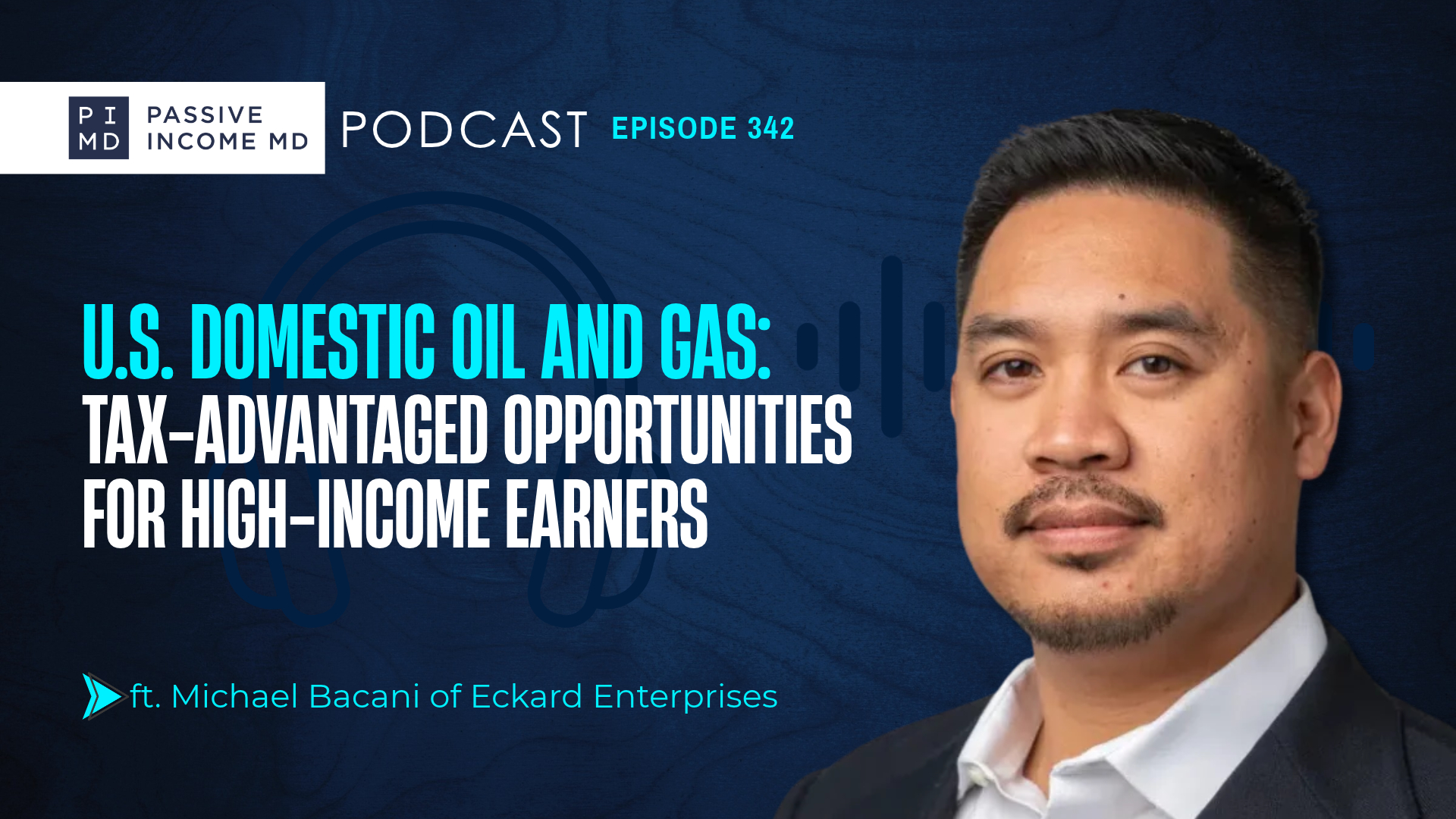
#342 U.S. Domestic Oil and Gas: Tax-Advantaged Opportunities for High-Income Earners ft. Michael Bacani of Eckard Enterprises



Episode Highlights
Now, let’s look at what we discussed in this episode:
- Why Taxes Come Up First
- How Intangible Drilling Costs Work
- Energy Demand and Why Investors Look at Oil and Gas
- How Investors Actually Get Paid
- Due Diligence, Red Flags, and Where to Start
Here’s a breakdown of how this episode unfolds.
Episode Breakdown
Why Taxes Come Up First
Peter introduces Michael Bacani, a senior wealth manager at Eckard Enterprises, a company that focuses on oil and gas, mineral rights, and working interests. Peter notes up front that he’s an investor at Eckard. He says Michael has become a familiar face at PIMDCON events, and attendees have given good feedback on their conversations with him, which is why he invited him on the podcast. Michael jokes that after attending the last four conferences he feels like a doctor by proxy.
Michael explains his role. He’s in his fifth year at Eckard, travels the country sitting down with investors, and focuses on education so they can decide whether Eckard’s strategies and products fit what they’re trying to accomplish. Before that he started his career as a life insurance agent at Northwestern Mutual and has been in finance since 2020. He found Eckard when Troy was building the wealth team. He says working with doctors, lawyers, and engineers feels like getting a free PhD, because their needs are so complex.
Peter asks what investors want to talk about first, and Michael’s answer is “taxes, taxes, taxes.” He says high-income earners, physicians especially, are always looking for ways to shelter taxes, and he repeats Troy’s line that you’re basically working from January 1st into June before you put a dollar in your own pocket. He says many investors are sorting through sponsors to figure out who’s legitimate, which for him comes down to track record. Peter frames the timing for listeners: taxes are our biggest cost, and people look for moves to make before year end.
How Intangible Drilling Costs Work
Peter asks Michael to explain intangible drilling costs, or IDCs, in plain terms. Michael starts with a caution. He’d rather people pay their taxes than chase a deduction, since a deduction is really a loss, and with oil and gas it should be an investment first. He says that when Eckard underwrites a deal, the goal is to find oil and gas they can extract and cash flow from for the next 25 to 30 years. He then explains that IDCs date back to 1986, when the government incentivized private investors to fund U.S. exploration at a time when drilling was closer to a 50-50 bet.
Michael says technology has changed a lot since then, with drilling in proven areas, horizontal drilling, and a bottom hole assembly that acts like a GPS for the drill bit about 15,000 feet underground. He says the incentive is still on the books, though. In his explanation, underground costs are deductible, and above ground costs are also deductible in year one because of the one big beautiful bill. He says that with the way Eckard structures its deals, investors can see a deduction of roughly 90 to 100 percent of their investment in year one. He adds that laws can change, so these numbers reflect what he sees today.
Peter puts the choice in simple terms: pay the government or put that money toward an asset that can build cash flow. He asks whether this window could change. Michael says anything could change, but he points out that the 1986 law has stayed in place under both Republican and Democratic administrations because both sides use the deduction. He mentions that the previous administration favored wind, solar, and nuclear, and says things could get harder, but that Eckard has worked through hurdles year after year.
Energy Demand and Why Investors Look at Oil and Gas
Peter asks about energy demand, given AI, data centers, and the news about the Iran conflict. Michael expects demand to keep rising and says the conflict showed the world is undersupplied. He uses U.S. numbers to make the point. In his words, the country consumes about 20 million barrels a day and produces 12 to 13 million in a strong market, and only about 60 percent of that can be refined here. He adds that AI would need roughly ten times today’s energy infrastructure to perform at its highest level.
Michael says that in an inflationary market, owning energy can act as a hedge against other investments. He points out that real estate and data center projects were often underwritten at lower commodity prices. With oil around $85 to $90 today and forward pricing around $75 to $80, he says a project can end up upside down once diesel and transportation costs come in higher. He’s clear that Eckard doesn’t want investors to be only in oil and gas, but he says it becomes a foundation for many of them.
Peter asks why there’s so much attention on this space now. Michael says the industry is newer than most people realize. He explains that 3D seismic, which he compares to a CT scan, arrived around 2010, and horizontal drilling and fracking became mainstream around 2015. Before that, he says, private investors had little economic case for the asset class, which is why people have horror stories about a great-grandfather who got scammed. He says investors are now looking beyond the S&P at alternatives like real estate and oil and gas.
How Investors Actually Get Paid
Peter asks Michael to walk through what happens after someone invests, using a $100,000 example. Michael says the investor calls their CPA to take the IDC deduction the day they invest, and from that point the money is at risk. Eckard then lines up long term contracts with vendors, the fracking team, and the completions team. He says it takes about a year to a year and a half to drill, complete, and turn the well to sales, so the first check usually arrives in that window. After that, he says, distributions are monthly for roughly 25 to 30 years.
Michael explains that a well doesn’t just stop at the end of that window. When its income no longer covers its expenses, he says the operator turns on another well, much like the large producers do. In his description, an investor in the first well, which recovers only around 10 to 12 percent of the reserves, gets first right of refusal on later wells. He frames it as a long term play, not a one and done investment, and compares it to how a major producer’s value comes from the reserves it still holds underground. He also notes that mineral lease terms generally favor the landowner, and he mentions that he likes Oklahoma, Texas, and North Dakota.
Michael describes two pockets in the space. Mineral rights are for investors who want cash flow today, and he calls it a safer barrier to entry with no tenants, no insurance, and no liabilities. Drilling is for investors who don’t need income right now and want to keep deferring taxes. He says those investors often put the income from their first well into the next one instead of taking it, so what they choose depends on their goals.
Due Diligence, Red Flags, and Where to Start
Reinvention Without Leaving Medicine YOU KNOW ALL TOO WELL THAT ENTREPRENEURSHIP CAN BE A LONELY BUSINESS.
If you are looking for a private, invitation-only Mastermind designed for physicians and high-performing professionals who will settle for no less than fulfilling their visions of success while helping others do the same — Momentum MD is for you!
Filling our next cohort now, limited spots are available! APPLY now!