
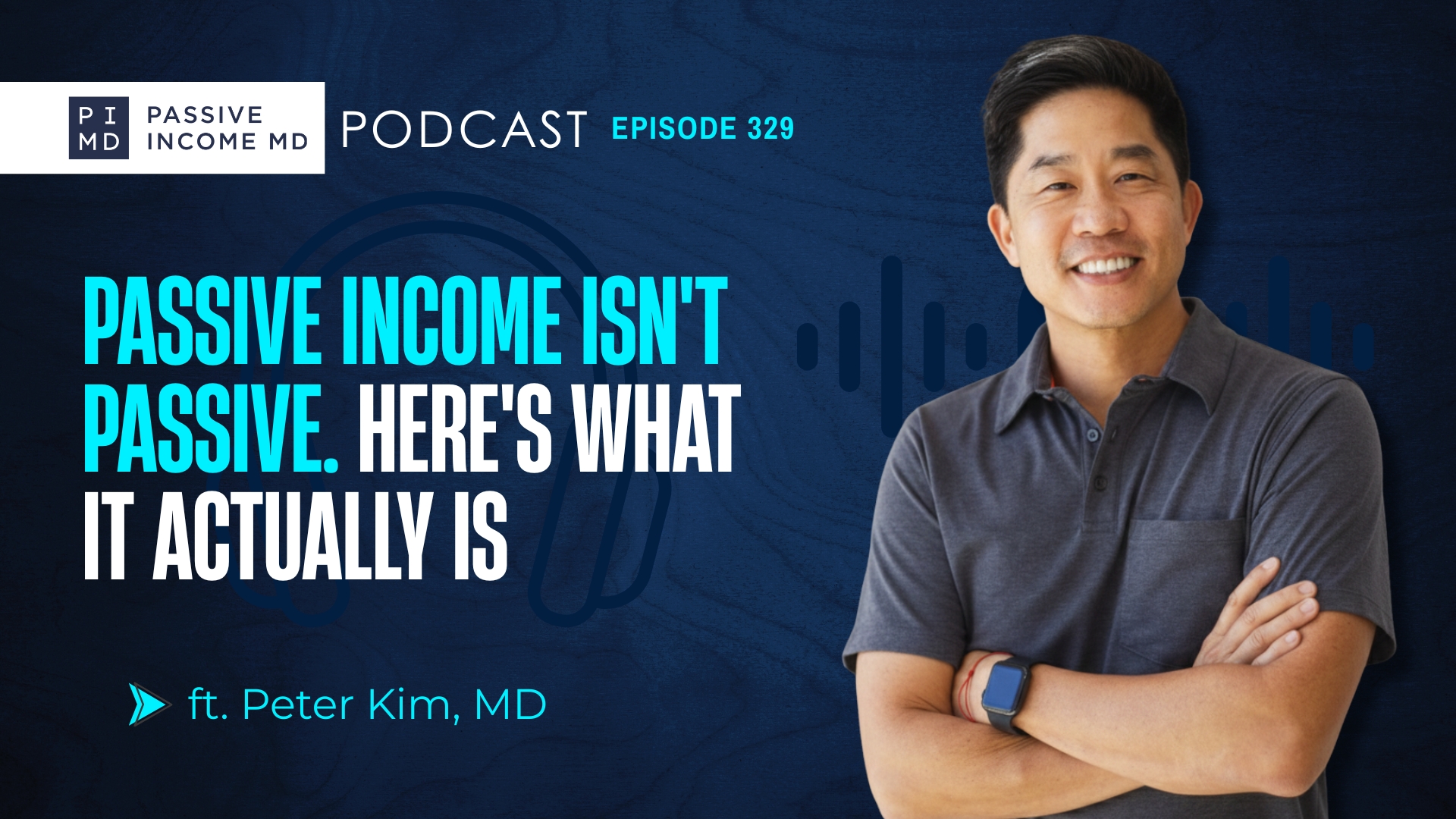
#329 Passive Income Isn’t Passive. Here’s What It Actually Is. ft. Peter Kim, MD


Episode Highlights
Now, let’s look at what we discussed in this episode:
- The Conversation That Sparked This Episode
- Why Medicine Is the Purest Form of Trading Time for Money
- Scalable Income Instead of Passive Income
- Why the Early Part Feels Flat, and What Actually Speeds It Up
- What He’d Tell That Guy Now
Here’s a breakdown of how this episode unfolds.
Episode Breakdown
The Conversation That Sparked This Episode
Peter opens with a story from a friend’s house, where he met a guy who, upon learning what Peter does, said flatly that he doesn’t believe passive income exists. The guy called it a fantasy, the idea that you can do nothing and get paid. Peter didn’t argue in the moment, but says he’s been thinking about that conversation ever since.
His take is that the guy wasn’t wrong about the thing he was describing, he was just describing the wrong thing entirely. Peter uses this as the jumping off point for the episode, promising to walk through what passive income actually is, why it matters more for physicians than almost anyone else, and how it’s actually built.
He’s upfront before diving in that everything he’s about to share is his own experience and thinking, not financial advice, and that people should take what’s useful and leave what isn’t.
Why Medicine Is the Purest Form of Trading Time for Money
Peter makes the case that medicine might be one of the purest examples of trading time for money in any professional career. No shift means no surgeries, no patients, no RVUs, and no income. There’s no version of clinical income that keeps flowing while you’re not physically there, and there’s a hard ceiling since there are only so many hours in a day.
He points out the cruel irony of vacations for physicians, where you’re not producing income and you’re paying to be away at the same time. Even paid time off, he argues, is already baked into your salary calculation, so stepping back for any reason still hits your bottom line. This is the world most people live in, constantly trading time for money without ever questioning the model.
Peter connects this directly back to the skeptic from the opening story. When that guy rejected the idea of passive income, Peter reframes it as the guy rejecting the idea that anyone could escape the same rule he’s lived by his entire life. And Peter actually gives him credit here, agreeing that if passive income means doing absolutely nothing and getting paid forever, that version genuinely doesn’t exist.
Scalable Income Instead of Passive Income
Peter explains that the word passive is misleading, and that he actually thinks of this concept as scalable income instead. Scalable income is income that isn’t proportional to the time you put into it, which is different from saying it requires zero time. Clinical income is the exact opposite, every dollar is tied directly to an hour, so doubling your income means roughly doubling your hours or your case load.
He shares a story from a friend, an anesthesiologist, whose patient complained about being charged for only 15 minutes in the room. The friend’s response, offering to take longer if that’s what the patient wanted, gets at the real point. The patient saw 15 minutes, not the years of residency and thousands of procedures that made those 15 minutes look effortless.
Peter draws the same parallel to passive income. People see a check show up and assume that’s the whole story, without seeing the invisible work behind it, learning how to evaluate a deal, do real due diligence, read financials, and know what questions to ask before putting money in. He’s honest that even solid due diligence doesn’t guarantee a good outcome every time, but it does improve your odds significantly over skipping that step entirely.
Why the Early Part Feels Flat, and What Actually Speeds It Up
Peter addresses the part of building scalable income that causes most people to quit early. In the beginning, it genuinely looks flat. You make your first investment, learn a hard lesson or two, and it doesn’t feel worth it compared to your clinical income. But he argues that sticking through that flat stretch is exactly what makes it compound later, since both your capital and your judgment are growing at the same time.
He shares his own first real estate check, a tiny amount that he still celebrated because it didn’t require putting a needle in anyone’s back to earn. From there, he lays out four levers that actually speed up that curve: reinvesting early cash flow instead of spending it, using leverage deliberately rather than recklessly, building a repeatable process instead of chasing one-off deals, and refusing to learn everything alone.
He brings up Larry Daugherty, a radiation oncologist who came to the very first PIMDCon with zero real estate knowledge and built a massive portfolio within a few years. Peter’s point is that what changed for Larry wasn’t luck, it was turning one property into a repeatable process, largely because he put himself in a room with people who were already a few steps ahead.
What He’d Tell That Guy Now
Reinvention Without Leaving Medicine YOU KNOW ALL TOO WELL THAT ENTREPRENEURSHIP CAN BE A LONELY BUSINESS.
If you are looking for a private, invitation-only Mastermind designed for physicians and high-performing professionals who will settle for no less than fulfilling their visions of success while helping others do the same — Momentum MD is for you!
Filling our next cohort now, limited spots are available! APPLY now!