
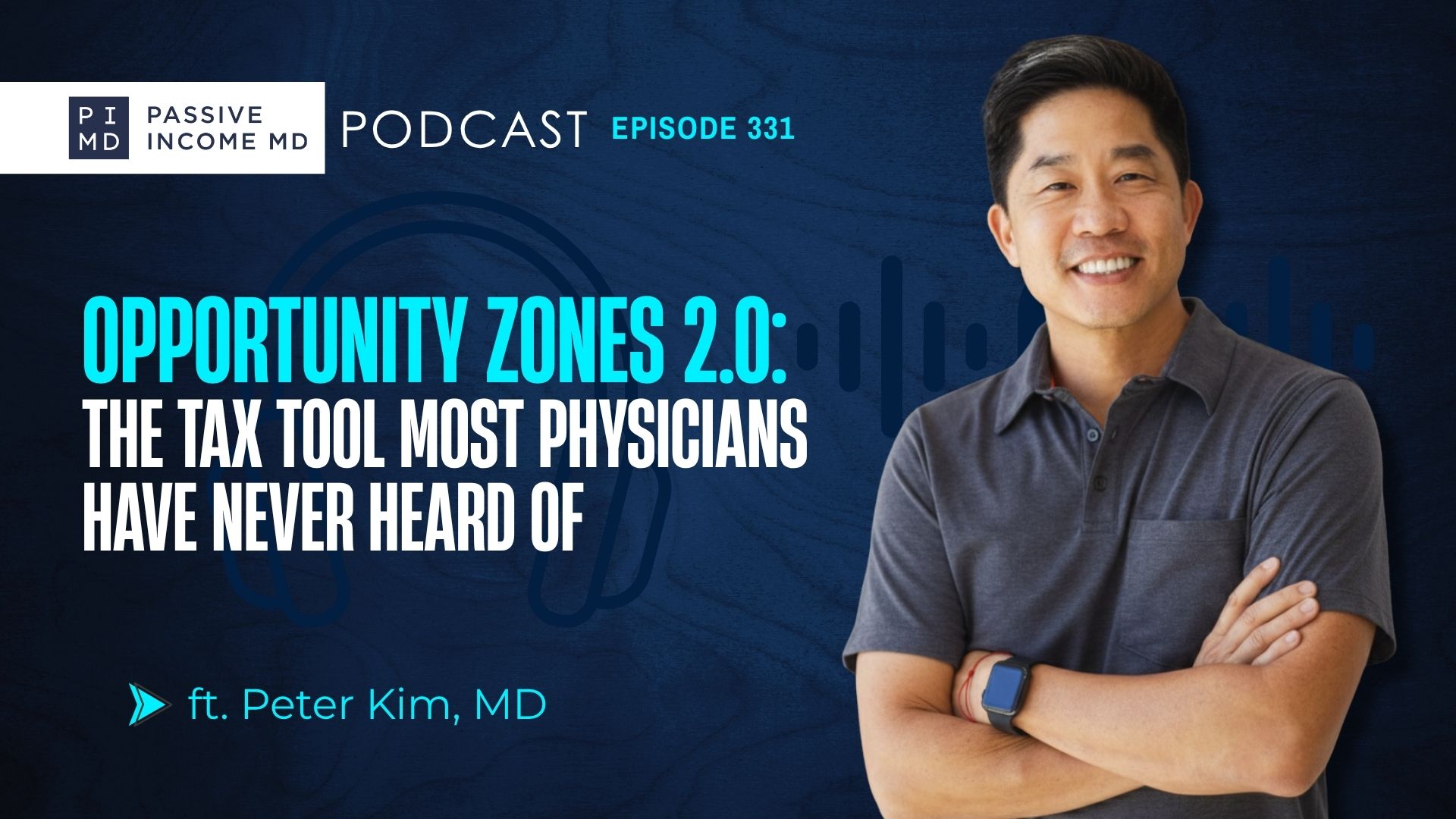
#331 Opportunity Zones 2.0: The Tax Tool Most Physicians Have Never Heard Of ft. Peter Kim, MD


Episode Highlights
Now, let’s look at what we discussed in this episode:
- The Question Most Investors Can’t Answer
- How Opportunity Zones Actually Work
- Why Congress Made This Permanent
- The Concentration Problem Nobody Talks About
- Five Steps Before You Actually Do This
Here’s a breakdown of how this episode unfolds.
Episode Breakdown
The Question Most Investors Can’t Answer
Peter opens by pointing out that the S&P has hit record highs more than two dozen times this year, and if you’ve got a brokerage account, you’ve probably felt it. He asks a simple question: if you sold some of those positions today, what would you actually do with the gain. Most people don’t have a good answer, so they just keep holding, not because it’s the right call, but because selling means a tax bill, and a tax bill feels like doing something wrong.
This sets up the topic for the episode, a tool Peter says almost none of the physicians he talks to have ever heard of, opportunity zones. He notes that the timing matters here specifically, because the version of this program that exists right now isn’t the same one that existed a few years ago.
Before diving in, he gives his usual disclaimer that everything he’s sharing is what he’s personally learned and looked into, not tax advice, and that every situation is different enough to warrant a conversation with an actual CPA.
How Opportunity Zones Actually Work
Peter walks through a concrete example to make the concept click. Say you bought a stock years ago for $50,000 and it’s now worth $150,000, giving you a $100,000 gain. With an opportunity zone investment, you only need to move that $100,000 gain into a Qualified Opportunity Fund, not the original $50,000 basis, and you have to do it within 180 days of the sale.
He breaks down the two different gains at play here. The first is the original $100,000 you deferred, which still comes due in taxes eventually, currently around 5 years after investing, but you get a 10% discount if you hold that long, meaning you’d only owe tax on $90,000 of it. The second gain is whatever that money earns once it’s inside the fund. If your investment grows to $200,000 by year 10, that new $100,000 in growth becomes completely tax free, not deferred, not discounted, fully tax free.
Peter backs this up by pointing out the original version of this program, launched in 2018, saw over $112 billion in qualified investment, with more than three quarters of designated zones actually receiving money. He also flags a time sensitive note for anyone who was part of that original program, since deferred gains from that version come due at the end of this year, making a call to a CPA worth doing now rather than later.
Why Congress Made This Permanent
Peter explains the biggest shift behind why this matters now. The original 2018 version of opportunity zones was never built to last. The map of eligible zones was drawn once, no new zones were ever added, and everyone raced toward the exact same deadline of December 31st of this year, regardless of when they actually invested.
Congress made the program permanent last year, and Peter breaks down what that word actually means in two specific ways. First, new zones now get drawn every 10 years on a rolling cycle, starting January 1st, 2027, with the first cycle under the new rules. Second, and more important for how anyone would actually use this, your personal clock as an investor starts the day you invest, not on some fixed date everyone shares.
He’s careful not to oversell it, noting there’s still an outer cap around 30 years, at which point your basis automatically steps up to fair market value. For most people planning a normal financial life, he says that limit isn’t really relevant. He also points out that the new map of eligible zones actually got smaller and more targeted this time around, which he sees as a good sign that this round will be run with more discipline than the first.
The Concentration Problem Nobody Talks About
Peter shifts into a broader point about what’s actually happening in a lot of portfolios right now. The market’s historic run has been driven largely by a small handful of companies, AI infrastructure and chipmakers among them, meaning a lot of people’s portfolios are more concentrated than they’d guess, simply because their winners kept winning.
He points out the trap this creates. People know they should rebalance a concentrated position, but they don’t, partly because selling a winner feels wrong and partly because the resulting tax bill feels outrageous. So the position just keeps growing more concentrated over time. This is exactly where an opportunity zone fund becomes useful, giving people a way to defer that tax hit while redeploying the money into a different asset class, in this case real estate.
He’s upfront about the tradeoff though. These funds are typically illiquid, meaning you’re generally committing to hold for 5 to 10 years to get the full benefit. This isn’t a way to access money faster, it’s a way to make a decision about gains you’re probably already avoiding, with the real payoff showing up later rather than immediately.
Five Steps Before You Actually Do This
Reinvention Without Leaving Medicine YOU KNOW ALL TOO WELL THAT ENTREPRENEURSHIP CAN BE A LONELY BUSINESS.
If you are looking for a private, invitation-only Mastermind designed for physicians and high-performing professionals who will settle for no less than fulfilling their visions of success while helping others do the same — Momentum MD is for you!
Filling our next cohort now, limited spots are available! APPLY now!