
How Physician Investors Should Actually Think About the Second Half of 2026
This post may contain links from our sponsors. We provide you with accurate, reliable information. Learn more about how we make money and select our advertising partners.
Most mid-year market outlooks do the same thing. They recap what happened, make a few educated guesses about what's coming, and send you off with a list of things to watch. They're not useless. But they're also not what most physician investors actually need right now.
What most physician investors need is a different frame altogether.
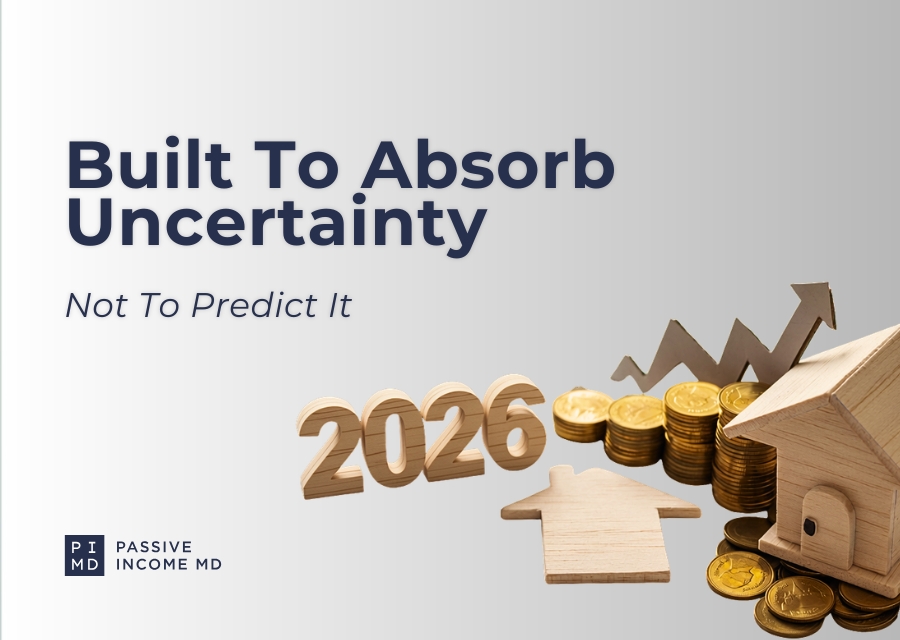
Not a better prediction. A better question. The question isn't “what's the market going to do in the second half of 2026?” The question is: “Is my financial life structured to handle multiple different versions of the next six months?”
Those are very different questions. And the answer to the second one is actually within your control.
Here's how I'm thinking about H2, what I'm personally doing, and why I think prediction is the wrong game right now.
Disclaimer: This article is for informational and educational purposes only and does not constitute financial, legal, or investment advice. Any investment involves risk, and you should consult your financial advisor, attorney, or CPA before making any investment decisions. Past performance is not indicative of future results. The author and associated entities disclaim any liability for loss incurred as a result of the use of this material or its content.

Nobody Called This Year
Before getting into positioning, it's worth naming something honestly.
Nobody predicted where we are in July 2026.
In December, most investors, myself included, were watching for rate cuts and hoping the real estate market was close to loosening up. There was genuine optimism that inflation was mostly behind us.
Then the conflict in Iran escalated. Energy prices spiked. Gasoline was up 40 percent year over year by May. Fuel oil nearly 59 percent. That fed directly into inflation, which hit 4.2 percent in May, the highest level since April 2023. The Fed held rates at 3.50 to 3.75 percent and dropped any easing bias entirely. A rate hike at the July 29th meeting is now a real possibility.
The stock market is up about nine percent year to date, which is a reasonable headline number. But the path to that nine percent included real drawdowns during the Iran escalation, a volatile period in chipmakers tied to AI infrastructure spending concerns, and meaningful concentration in a narrow band of the index. The experience of the year has not matched the scoreboard.
And real estate has stayed in the higher-for-longer holding pattern that has made deals harder to underwrite, kept operators cautious, and left a lot of would-be physician investors waiting for clarity that hasn't fully arrived.
The point isn't that any of this is catastrophic. It isn't. The point is that none of it was on most people's radar in December. The people who claimed to see it coming mostly saw it afterward.
That matters for how you think about the next six months.
On Real Estate: Patient Is Not the Same as Sitting Out
If you've been holding off on real estate because the environment has been difficult, the posture probably still makes sense. But there's a meaningful difference between being patient and being passive.
Patient means actively watching deals, maintaining relationships with operators you trust, understanding what's in your market, and being positioned to move when the conditions make sense. Passive means waiting for someone to tell you it's time.
The data is starting to shift. CBRE is projecting commercial real estate investment activity to increase sixteen percent this year. Their research points toward the highest returns of this cycle coming in the next several quarters, as the new construction pipeline thins and fundamentals recover. Multifamily vacancy rates are sitting around 4.4 percent. New supply, particularly in Sun Belt markets, is starting to work through the system.
This doesn't mean every deal makes sense right now. Borrowing costs are still elevated, and the underwriting environment requires more discipline than it did in 2021. But it does mean that the physicians who are informed, ready, and in relationship with quality operators are in a different position than the ones who stepped back entirely.
If you haven't looked at a deal in a year, now is the time to start. Not to rush into something. Just to know the landscape when the right opportunity shows up.
On Equities: Boring Still Wins
There isn't much to say here, and that's actually the point.
Consistent index fund investing. Same as before. The market is up nine percent year to date, and I didn't need to make a single prediction or a single clever move to participate in that. I just needed to not react when the market dropped in February and March, not react when Iran made headlines, and not react when chipmakers sold off.
Index funds capture all the major companies. You don't need to pick winners in a market this concentrated and this driven by AI spending dynamics. You need to stay consistent and not get in your own way.
The physicians who got hurt in 2026 reacted to volatility. The ones who are fine didn't. That pattern has repeated itself across every cycle I've watched. It doesn't stop being true just because a given year feels more uncertain than usual.
If you're the type who checks your portfolio every time a headline hits, the most valuable thing you can do for your long-term returns is stop doing that.
On Taxes: The Meeting Most Physicians Never Schedule
This is where I'm spending the most active energy right now, and it has nothing to do with predicting what the market does next.
I scheduled a meeting with my CPA this summer. Not in November. Not in December. This summer.
For most of my life, tax planning meant a late-fall conversation where my CPA and I were mostly talking about what we should have done rather than what we could still do. By the time December arrives, many of the most impactful moves are already off the table. The decisions that actually reduce your tax burden, the entity structures, the timing of income recognition, the strategic use of depreciation, those decisions need to happen earlier in the year to implement properly.
The physicians in our community who are genuinely winning on taxes aren't doing anything exotic. They're having the conversation earlier. A summer meeting gives you runway. A December meeting gives you regret.
If you haven't spoken to your CPA since you filed your return, schedule something in August. Come in with your projected income for the year, a list of your current investments, and any changes to your income streams. That conversation, done now, is worth far more than the same conversation done in late November.
Taxes are one of the few areas where physician investors have direct control regardless of what the market does. It's worth treating it that way.

Subscribe to receive the 7 Steps you can follow to achieve Financial Freedom
If financial freedom is your goal, there’s no better time to get started than right now.
Unlock actionable steps that you can take every day to fine-tune your goals, discover your interests, and avoid costly mistakes on your financial freedom journey.
The Through-Line
Here's what connects real estate patience, consistent equities, and proactive tax planning.
None of them require being right about what's coming.
That's the design feature, not a side effect. The physicians I watch who are in genuinely good financial shape didn't get there by calling markets or predicting rate moves. They built financial lives that work across multiple versions of an uncertain future. Income from more than one source. Passive cash flow that isn't dependent on a good market week. A tax position they actually manage.
When the world doesn't cooperate with the forecast, and in 2026 it has repeatedly not cooperated, their financial lives absorb it rather than break under it.
That's the real goal of building passive income. Not a specific number or a specific timeline. Something resilient.
The second half of 2026 is going to continue to be unpredictable. The war, the Fed, the market, inflation. None of it is settled. But your financial position doesn't have to depend on how any of it resolves.
If you want to think through this alongside other physicians doing the same work, PIMDCON is in Dallas this September, September 24th through 26th. It's the right room for this conversation. Details at pimdcon.com.
Were these helpful in any way? Make sure to sign up for the newsletter and join the Passive Income Docs Facebook Group for more physician-tailored content.
Peter Kim, MD is the founder of Passive Income MD, the creator of Passive Real Estate Academy, and offers weekly education through his Monday podcast, the Passive Income MD Podcast. Join our community at the Passive Income Doc Facebook Group.
Disclaimer: I am not a CPA, attorney, or financial advisor. The information in this post is for educational purposes only and should not be construed as tax, legal, or financial advice. Please consult a qualified professional about your specific situation before making any decisions.
Further Reading
Disclaimer: The topic presented in this article is provided as general information and for educational purposes. It is not a substitute for professional advice. Accordingly, before taking action, consult with your team of professionals.