

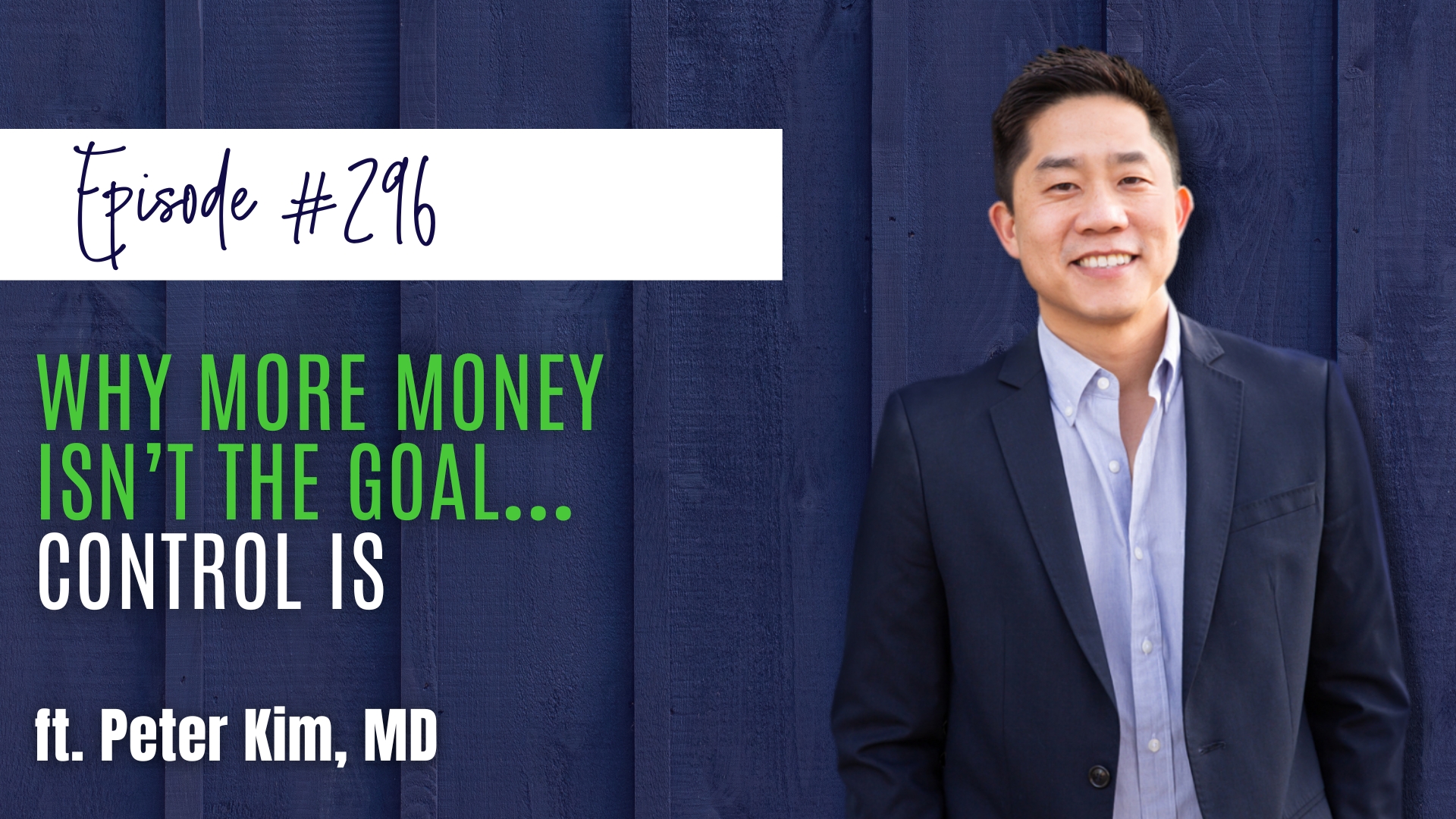
#296 Why More Money Isn’t the Goal… Control Is ft. Peter Kim, MD


Episode Highlights
Now, let’s look at what we discussed in this episode:
- Time, Not Money, Is the Real Goal
- The Hidden Cost of Always Saying Yes
- Reframing the Conversation About Money
- The Three Levers That Create Control
- Small Wins That Change Everything
Here’s a breakdown of how this episode unfolds.
Episode Breakdown
Time, Not Money, Is the Real Goal
Peter opens the episode by challenging a common assumption: that doctors are primarily motivated by earning more money. He shares his belief that most physicians are actually seeking more time. Time with family, time to rest, and time to be present in their own lives. From the very beginning, he frames the conversation around the idea that income is often a means to an end, not the end itself.
He explains that many doctors eventually reach a point where they realize life is short and opportunities are fleeting. The years that matter most, especially those involving family and health, are happening right now, not “someday.” This realization often creates tension when physicians feel stuck trading more and more time for income.
The Hidden Cost of Always Saying Yes
Peter describes a familiar pattern among high-earning physicians who appear successful on paper but feel constantly rushed and exhausted in real life. He talks about the unspoken tension many doctors carry. Always being busy, always tired, and always telling themselves that things will slow down later.
He explains how fear often plays a role in this cycle. Fear of contracts changing, administrators making decisions, or unexpected life events can drive doctors to overfill their schedules.
As a result, they say yes to everything: extra patients, committees, and responsibilities… often at the expense of their own well-being.
Reframing the Conversation About Money
Peter acknowledges that talking about money is uncomfortable in medicine. He reflects on how most doctors didn’t choose the profession to get rich, but rather out of purpose, passion, and a desire to contribute. Because of this, discussing finances can feel wrong or even taboo.
He explains that the point of talking about money isn’t greed. Instead, it’s about recognizing a fundamental truth: life, energy, and opportunity are finite. Children grow up, health changes, and moments don’t wait until it feels convenient to enjoy them.
This leads to an important shift in perspective. Peter notes that many physicians eventually stop asking how much money they can make and start asking how to make the most of their time. In this reframing, time becomes the ultimate asset, and control becomes the way to protect it.
The Three Levers That Create Control
Peter introduces what he calls the three levers of control that help physicians regain agency over their lives. The first lever is increasing income, which most doctors understand well. However, he points out that if income requires constant presence, it’s simply another job that owns your time.
The second lever is reducing financial drag. Peter explains that factors like high taxes, lifestyle creep, and bad debt quietly slow progress. By reducing this drag, physicians can create breathing room without necessarily earning more. This margin, he says, is what begins to open up real options.
The third lever, and his favorite, is income that isn’t tied to hours worked; what he broadly refers to as passive income. Whether it comes from real estate, businesses, or other vehicles, the key is unlinking time from money. That separation is where meaningful control starts to appear.
Small Wins That Change Everything
Peter emphasizes that doctors don’t need to replace their entire income to feel a difference. Even a small amount of separation between time and money can create noticeable change. Progress, such as being able to say no to one shift or one holiday, can dramatically alter how physicians show up in their lives.
He describes how this growing sense of control reduces fear-driven decision-making. Work may still exist, but the constant urgency, stress, and panic begin to fade. With that pressure lifted, doctors often become more present at home and more intentional at work.
Peter closes the episode with a reflection on regret. He shares that people rarely wish they had worked more or taken more shifts. Instead, they wish they had more time with the people and activities they love. His final message is clear: money isn’t the goal. Time is the asset, and control is what allows physicians to live and practice medicine on purpose.
YOU KNOW ALL TOO WELL THAT ENTREPRENEURSHIP CAN BE A LONELY BUSINESS.
If you are looking for a private, invitation-only Mastermind designed for physicians and high-performing professionals who will settle for no less than fulfilling their visions of success while helping others do the same — Momentum MD is for you!
Filling our next cohort now, limited spots are available! APPLY now!